
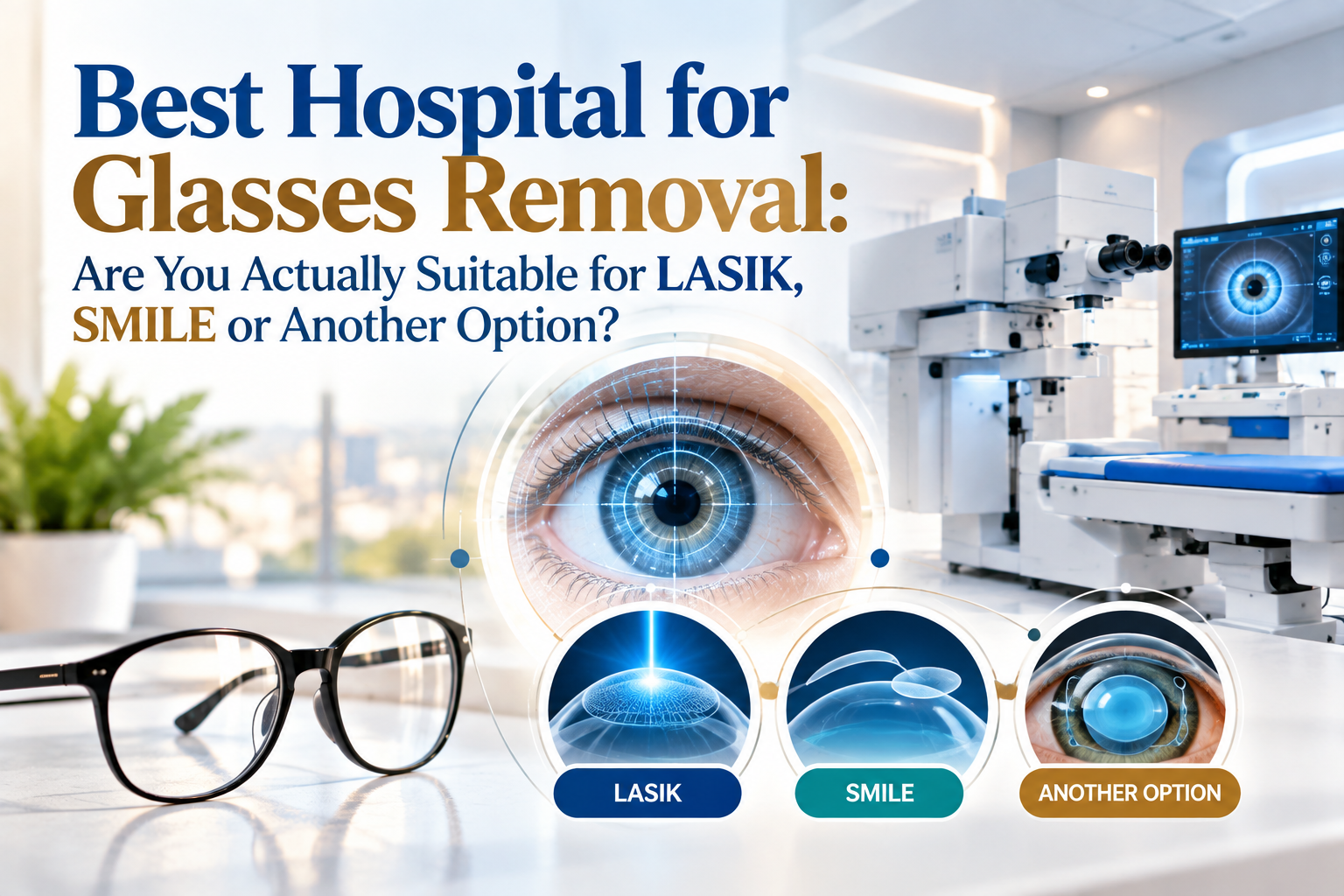
Searching for the best hospital for glasses removal often starts with a simple goal: to reduce dependence on spectacles or contact lenses. But the safest route to that goal does not begin with choosing a procedure. It begins with finding out whether your eyes are suitable for refractive surgery at all, and if they are, which approach fits your cornea, prescription, age, tear-film health and visual needs.
That distinction matters because “glasses removal” is an umbrella term. Depending on the patient, the discussion may include LASIK, SMILE, an implantable lens such as ICL, or an age-specific strategy for people who have developed presbyopia after 40. Two people with a similar spectacle number may receive different recommendations because their corneal shape, thickness, dry-eye status, pupil characteristics, eye health and lifestyle are not identical.
For patients in Delhi, especially Pitampura, Rohini, Rani Bagh, Shalimar Bagh and nearby North-West Delhi areas, a useful way to judge a best hospital for glasses removal is to ask a different question: does the centre perform a proper suitability work-up and offer more than one vision-correction pathway when clinically appropriate? A good consultation should explain not only what can be done, but also when surgery should be postponed, modified or avoided.
Bajaj Eye Care Centre in Pitampura lists refractive vision-correction services including LASIK and SMILE on its official website, along with other eye-care services. The centre is NABH accredited and has been operating from Pitampura since 1996 according to its current website. You can review the centre here: https://www.bajajeyecarecentre.com/
Refractive surgery changes the way light is focused so that dependence on glasses or contact lenses may be reduced. The American Academy of Ophthalmology notes that LASIK candidacy depends on factors such as age, a reasonably stable prescription, treatable refractive error, healthy and sufficiently thick corneas, generally good eye health and realistic expectations. The FDA similarly advises patients to consider prescription stability, corneal thickness, tear production, pupil size, existing eye conditions and procedure limitations before surgery.
In practical terms, this means a responsible glasses-removal consultation should not start with a sales pitch for one laser. It should start with measurements and a medical examination. The purpose of screening is to find the safest match between the eye and the available correction options, and to identify people who may benefit more from a non-laser alternative or from treatment of another eye problem first.
This is also why a centre that evaluates multiple pathways can be useful. Bajaj Eye Care Centre’s dedicated glasses-removal page describes SMILE, blade-free LASIK and ICL as different routes that may be considered after individual evaluation: https://www.bajajeyecarecentre.com/best-hospital-for-glasses-removal.html
A changing prescription can make it difficult to plan a durable refractive correction. For many adult patients, one of the first questions is whether the spectacle number has remained reasonably stable over the previous year. A small change does not automatically rule out surgery, but an actively changing prescription requires careful assessment and may be a reason to wait.
Prescription stability can be especially relevant in younger adults, during pregnancy-related hormonal changes, or when certain health conditions affect refraction. The final decision should be based on an eye examination rather than age alone.
LASIK and SMILE are corneal refractive procedures, so the shape and structural health of the cornea are central to candidacy. Corneal topography or tomography can help identify irregular shape patterns that may change the treatment plan. Screening is also important for detecting conditions such as keratoconus or other corneal abnormalities that can make corneal laser surgery inappropriate.
A patient may have a common spectacle power yet still be unsuitable for a particular laser procedure because the corneal geometry is not appropriate. This is one of the clearest reasons not to choose surgery based only on an advertised dioptre range.
Laser vision correction reshapes corneal tissue. The amount of tissue involved depends on the refractive error and procedure design. Corneal thickness therefore forms part of the safety calculation. The FDA specifically identifies thin corneas as a risk factor that must be considered before LASIK.
A thinner cornea does not automatically mean a person can never reduce spectacle dependence. It may mean that a different procedure should be discussed. For some patients, an implantable lens option may be considered because it does not rely on removing corneal tissue. This is a clinical decision that requires detailed measurements.
Dry-eye symptoms deserve attention before refractive surgery because laser procedures can temporarily worsen dryness, and significant pre-existing dry eye can affect comfort, healing and visual quality. Symptoms may include burning, grittiness, fluctuating blur, redness, watering or discomfort with prolonged screen use.
A good pre-operative assessment should therefore include the ocular surface and tear film. If dryness is significant, the ophthalmologist may recommend treating it before making a final decision about surgery. Bajaj Eye Care Centre lists dry-eye evaluation among its eye-care services on its website, which is relevant because surface health and refractive planning are closely connected.
Glasses removal is not only about the cornea. A comprehensive examination should look for other eye conditions that can affect vision or change the treatment choice. Cataract, glaucoma, retinal disease, active inflammation, previous eye surgery or other ocular problems may alter what is appropriate.
For example, a patient in the typical cataract age group may not benefit from treating only the cornea if lens opacity is already the main reason for reduced vision. Similarly, unexplained visual symptoms should be investigated before an elective refractive procedure is planned.
Age does not create one universal cut-off for glasses removal, but it changes the discussion. Younger adults commonly seek distance spectacle independence for myopia or astigmatism. After around 40, many people develop presbyopia, which reduces the eye’s natural ability to focus at near. This means that correcting distance vision alone does not necessarily remove the need for reading glasses.
Patients above 40 should therefore ask specifically about near, intermediate and distance vision rather than using the broad phrase “remove my glasses.” Bajaj Eye Care Centre’s current website lists Presbyond among its glasses-free options for the 40+ age group. The important point is that suitability must still be established individually and expectations should be discussed before treatment.
A person who drives at night for work, competes in contact sports, spends long hours on digital screens or works in a profession with specific visual standards may need a different discussion from someone whose daily activities are less visually demanding. Pupil size, existing glare or halos, occupational requirements and the risk of eye trauma can all influence planning.
The FDA advises patients to understand possible visual symptoms after LASIK, including glare, halos, starbursts, double vision or reduced low-contrast quality in some cases. These possibilities should be discussed clearly before surgery, particularly for people who depend heavily on night driving.
The goal of refractive surgery is to reduce refractive error and dependence on spectacles or contact lenses. It should not be presented as a guarantee that a person will never need glasses again for any purpose. Some people may still require glasses for specific tasks, and age-related changes can affect vision later even after a successful procedure.
The best hospital for glasses removal should therefore be comfortable explaining limitations, alternatives and possible future spectacle needs. A patient who understands the trade-offs is in a better position to make an informed decision.
Once suitability screening is complete, the ophthalmologist can discuss which category of correction is most appropriate. The names of procedures matter less than the clinical match between the patient and the procedure.
LASIK treats refractive error by creating a corneal flap and reshaping underlying corneal tissue with laser. It is used for common refractive errors including myopia, hyperopia and astigmatism within appropriate treatment ranges. Candidacy depends on stable refraction, corneal measurements, tear-film health and the absence of contraindicating eye conditions.
For patients researching LASIK in Delhi, Bajaj Eye Care Centre has a dedicated LASIK information page describing its refractive services: https://www.bajajeyecarecentre.com/best-lasik-hospital-in-delhi.html
SMILE, or Small Incision Lenticule Extraction, corrects eligible refractive errors through a small corneal incision without creating a LASIK-style flap. It is performed with a femtosecond laser platform. Suitability still depends on the patient’s refractive error, corneal shape, thickness and overall eye health.
Bajaj Eye Care Centre’s official SMILE page describes the procedure and the ZEISS VisuMax platform used at the centre: https://www.bajajeyecarecentre.com/smile-laser-eye-surgery-in-delhi-laser-eye-surgery-in-delhi-lasik-surgery-in-delhi.html
An implantable collamer lens, commonly called ICL, is placed inside the eye while the natural lens remains in place. Because it does not rely on laser tissue removal from the cornea, it may enter the discussion for selected patients with high refractive error or corneal characteristics that make laser correction less suitable. ICL has its own measurements, risks and eligibility requirements, so it is not simply a substitute that works for everyone who cannot have LASIK.
The important search-intent point for patients is this: being told that you are “not suitable for LASIK” should not end the conversation. It should lead to a careful explanation of why, whether the reason is temporary or permanent, and whether another medically appropriate route exists.
From the early-to-mid 40s onward, presbyopia becomes increasingly relevant. A patient may have excellent distance correction and still struggle with mobile phones, menus or small print because the natural lens has lost some focusing flexibility. This is why a glasses-removal plan for a 45-year-old cannot be identical to one for a 25-year-old.
Age-specific refractive strategies may aim to balance distance and near requirements, but they need careful counselling and testing. Patients should ask what vision range the proposed treatment is designed to improve and whether reading glasses could still be needed afterward.
A high-quality consultation should be diagnostic before it is procedural. You should leave knowing what your refractive error is, whether your prescription is stable, what your corneal measurements show, whether the ocular surface is healthy, and whether any other eye condition changes the plan.
You should also understand why one option is preferred over another. “This is our newest machine” is not a clinical reason. A more useful explanation sounds like: your measurements support this procedure, these are the alternatives, these are the expected benefits, these are the relevant risks, and these are the situations in which you may still need glasses.
If the first recommendation is made before adequate testing, or if every patient appears to be offered the same procedure, it is reasonable to ask more questions or seek another opinion.
When a clinic offers only one refractive procedure, the patient may wonder whether the recommendation is being shaped by the available technology. A centre that evaluates several approaches can compare them against the patient’s measurements and visual goals. That does not mean every option is suitable for every person; it means the decision can be based on fit rather than availability alone.
Bajaj Eye Care Centre’s current website presents multiple vision-correction pathways, including SMILE, LASIK, ICL and Presbyond, alongside comprehensive eye-care services. Its recent glasses-removal article also emphasizes choosing a procedure according to eye measurements rather than assuming one technique is universally best: https://www.bajajeyecarecentre.com/blog/best-hospital-for-glasses-removal-in-delhi/
This approach is particularly relevant for people who search “best hospital for glasses removal” after being rejected for LASIK elsewhere, after developing dry-eye symptoms with contact lenses, after a major prescription change, or after entering the presbyopia age group. Their real need is not a generic laser. It is a diagnosis-driven pathway.
Elective refractive surgery may need to be postponed or reconsidered when the prescription is unstable, significant dry eye is untreated, the cornea is abnormal or too thin for the planned procedure, there is an active eye disease, or another condition such as cataract is the more important cause of visual difficulty. Certain systemic illnesses, medications or healing-related issues may also require special assessment.
Pregnancy and breastfeeding can be associated with temporary refractive and ocular-surface changes, so timing should be discussed with the treating ophthalmologist. People in occupations with formal visual standards should also verify whether a particular procedure is acceptable for their role before proceeding.
A “not now” decision can be a sign of good clinical judgment. The purpose of screening is not to qualify as many patients as possible. It is to identify the patients for whom the expected benefit is reasonable and the risk profile is acceptable.
Patients often define success as 6/6 or 20/20 vision without glasses, but a useful outcome discussion is broader. It may include visual comfort, quality at night, stability, near-vision needs, dry-eye symptoms, the possibility of enhancement, and whether glasses remain useful for certain tasks.
Because the eye continues to age, refractive surgery does not freeze vision permanently at one biological stage. Presbyopia, cataract and other age-related changes can develop later. A responsible plan therefore combines the immediate refractive goal with realistic long-term expectations.
Instead of relying on advertising language, compare eye centres using criteria that directly affect clinical decision-making. The following checklist is more useful than choosing on price or a single technology name:
For patients who want more detail on how Bajaj Eye Care Centre presents its glasses-removal services, the dedicated page is available at https://www.bajajeyecarecentre.com/best-hospital-for-glasses-removal.html
Bajaj Eye Care Centre is located at 101, Vikas Surya Plaza, Plot No. 7, DDA Community Centre, Road No. 44, Pitampura, Delhi 110034, near M2K Pitampura / Rani Bagh. The official contact page lists +91-9811219959 and 011-47024919 for appointments and enquiries.
Patients travelling from Pitampura, Rohini, Rani Bagh, Shalimar Bagh, Wazirpur, Ashok Vihar, Paschim Vihar and other parts of North and North-West Delhi can confirm clinic timings and appointment availability before visiting. Official contact details: https://www.bajajeyecarecentre.com/eye-care-hospital-in-pitampura-eye-hospital-in-pitampura-eye-clinic-in-pitampura-ophthalmology-clinic-pitampura-rani-bagh-west-delhi.html
The best hospital for glasses removal is not defined by one laser or one advertised procedure. Look for a centre that performs a detailed suitability assessment, evaluates corneal shape and thickness, checks dry-eye and overall eye health, explains alternatives such as LASIK, SMILE or an implantable lens when relevant, and discusses risks and realistic expectations before treatment.
Suitability cannot be confirmed from your spectacle power alone. It generally requires a stable prescription, detailed refraction, corneal measurements, ocular-surface assessment and a comprehensive eye examination. The ophthalmologist also considers age, eye disease, previous surgery, lifestyle and visual expectations.
Thin or structurally unsuitable corneas can make some corneal laser procedures inappropriate. Whether another option is possible depends on your complete eye measurements and health. In selected patients, a non-corneal option such as ICL may be discussed, but it has separate eligibility requirements.
It depends on the severity and cause of the dry eye. Significant untreated dryness may need to be managed before a final refractive-surgery decision. Dry-eye evaluation is important because LASIK can worsen dryness in some patients, at least temporarily.
No single procedure is best for everyone. SMILE and LASIK differ in technique and treatment range, and the choice depends on refraction, corneal measurements, ocular surface, lifestyle and other clinical factors. A personalised recommendation is more important than choosing by procedure name.
Ask why you are unsuitable. The reason may be related to corneal thickness, corneal shape, dry eye, prescription range, eye disease or another factor. Depending on the cause, the ophthalmologist may recommend treatment first, observation, a different refractive procedure or continued use of glasses/contact lenses.
People above 40 can still be evaluated for refractive options, but presbyopia changes the goal because near vision becomes an important part of the decision. The consultation should cover distance, intermediate and near vision and the possibility that reading glasses may still be needed.
No. Refractive surgery can reduce dependence on glasses or contact lenses, but no responsible consultation should guarantee permanent freedom from all glasses. Residual refractive error, specific visual tasks and age-related changes such as presbyopia or cataract can create future spectacle needs.
Testing varies by patient and procedure, but commonly includes refraction, corneal shape and thickness assessment, ocular-surface evaluation and a complete eye-health examination. Additional tests may be required if the doctor identifies a specific concern or if an intraocular option is being considered.
Bajaj Eye Care Centre is at 101, Vikas Surya Plaza, Plot No. 7, DDA Community Centre, Road No. 44, Pitampura, Delhi 110034, near M2K Pitampura / Rani Bagh. The official website lists +91-9811219959 and 011-47024919. Patients should call to confirm current consultation timings and appointment availability.
If you are considering reducing your dependence on spectacles, the most useful first appointment is a suitability assessment rather than a commitment to a specific surgery. Bring your current glasses or contact-lens prescription, details of previous eye treatment or surgery, and a list of medications or health conditions that may be relevant.
Bajaj Eye Care Centre, Pitampura, Delhi
Address: 101, Vikas Surya Plaza, Plot No. 7, DDA Community Centre, Road No. 44, Pitampura, Delhi 110034 (Near M2K Pitampura / Rani Bagh)
Phone: +91-9811219959 | 011-47024919
Website: https://www.bajajeyecarecentre.com/
The search for the best hospital for glasses removal should lead to a centre that is willing to measure first and recommend second. Stable prescription, corneal health, corneal thickness, tear-film status, eye health, age, lifestyle and realistic expectations all influence whether refractive surgery is suitable and which option deserves consideration.
LASIK may be appropriate for one patient, SMILE for another, an implantable lens for someone whose corneal parameters or prescription make laser correction less suitable, and an age-specific approach for a patient dealing with presbyopia after 40. Some people may be advised to treat dry eye or another eye condition before reconsidering surgery. Others may be advised that spectacles remain the safest option.
That is why a proper pre-operative evaluation is not a formality. It is the foundation of refractive-surgery safety. For patients in Delhi exploring glasses removal, Bajaj Eye Care Centre’s official website provides details of its services, location and appointment contacts at https://www.bajajeyecarecentre.com/
 153 Google reviews
101, Vikas Surya Plaza, Plot No -7, DDA Community Centre, Road No-44, Pitampura Delhi (Near M2K Picture Hall Pitampura, Rani Bagh, New Delhi, Delhi 110034
+91-9811219959 / 011-47024919 | bajaj_eyecare@yahoo.co.in
Eye Hospital In Delhi | Eye Hospital Near Me | Eye Clinic Near By


