
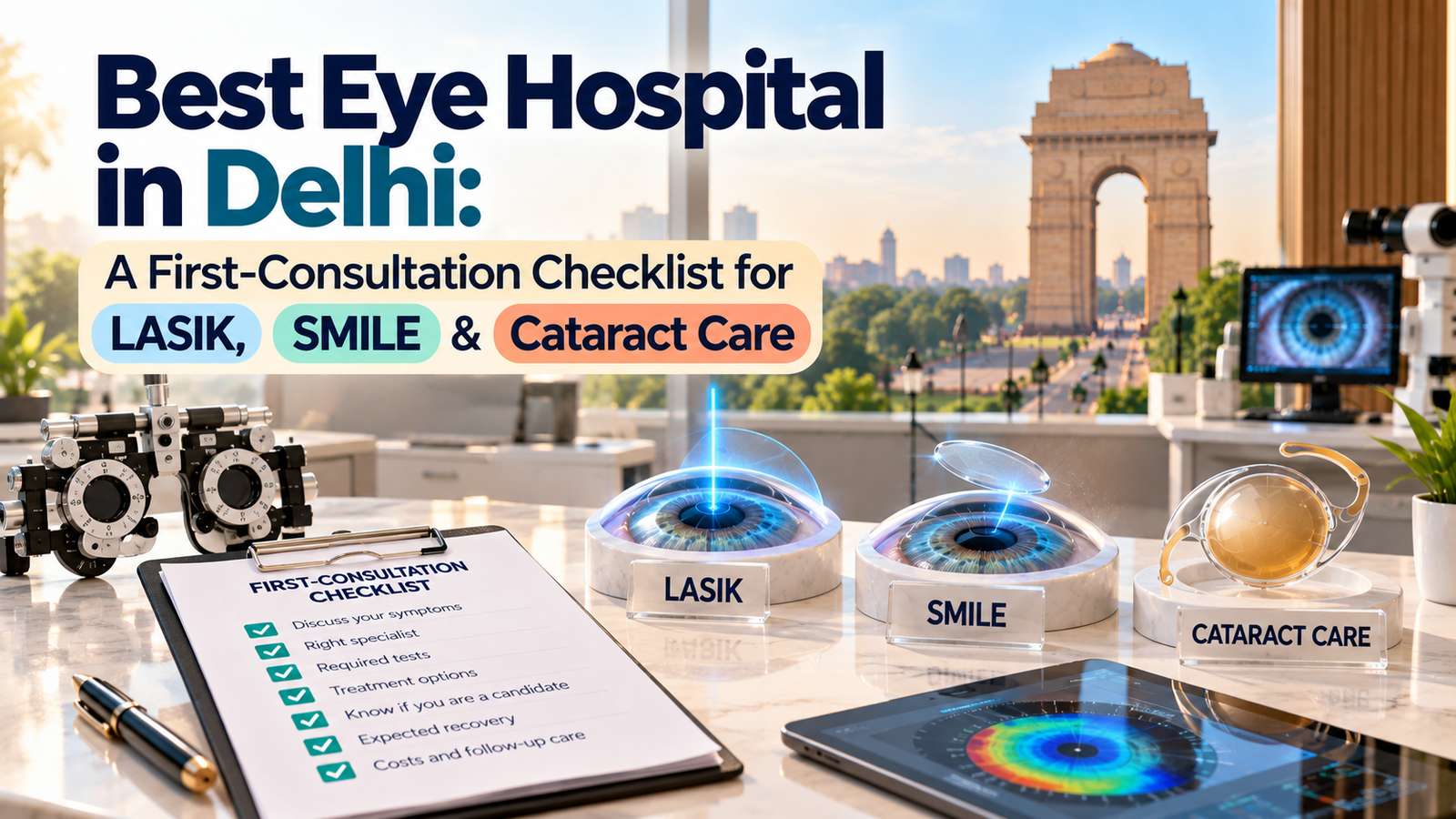
Searching for the best eye hospital in Delhi often starts with a simple concern: blurry vision, frequent changes in spectacle power, difficulty seeing at night, cataract symptoms, or the wish to reduce dependence on glasses. The search becomes more complicated once patients begin comparing LASIK, SMILE, cataract surgery, eye doctors, technology and treatment costs. A useful way to make the decision easier is to focus first on the quality of the consultation rather than on a single advertisement or procedure name.
A thorough eye consultation should do more than confirm your spectacle number. It should identify the reason for your visual problem, assess the health of the cornea, lens, retina and optic nerve when relevant, explain whether a procedure is appropriate, discuss alternatives and give you enough time to understand benefits, limitations and possible risks. This is especially important when considering refractive surgery such as LASIK or SMILE, or when planning cataract surgery.
Bajaj Eye Care Centre is located in Pitampura, Delhi and provides services including comprehensive eye care, cataract treatment, blade-free LASIK, SMILE laser eye surgery, glaucoma care, retina services, dry-eye evaluation, keratoconus care and paediatric ophthalmology. The centre’s official website states that it is NABH accredited and was established in 1996. Dr. Rajiv Bajaj, MBBS, MS (Ophthalmology), is the founder and an ophthalmologist practising at the centre.
This guide is designed for patients who are comparing an eye hospital in Delhi and want to know what should happen before any treatment decision is made. It focuses on the first consultation, the questions worth asking and the differences between common treatment pathways.
Official website: https://www.bajajeyecarecentre.com/
A common mistake is deciding on a procedure before the eye has been properly evaluated. A patient may arrive asking for LASIK because a friend had it, while another may assume that every age-related vision problem is a cataract. In reality, similar symptoms can have different causes. Blurred vision may be related to refractive error, cataract, dry eye, corneal disease, retinal conditions or other eye problems.
The first responsibility of an eye-care consultation is therefore diagnostic clarity. The doctor should understand your symptoms, medical history, current glasses or contact-lens use, previous eye treatment and any medicines that could affect the eyes or healing. Depending on the complaint, the examination may include visual-acuity testing, refraction, slit-lamp examination, eye-pressure measurement, corneal assessment and evaluation of the retina after dilation.
For someone searching for the best eye doctor in Delhi, this diagnostic approach matters more than immediately being offered a surgery. A responsible treatment plan begins with determining what is wrong, whether treatment is required now and which options are medically suitable.
LASIK is intended to reduce dependence on glasses or contact lenses by reshaping the cornea. It is not suitable for every person who wears spectacles. Before recommending refractive surgery, the treating eye surgeon should evaluate whether the prescription is stable and whether the cornea is healthy enough for treatment.
Important pre-operative considerations can include corneal thickness and shape, tear-film status, refractive stability, pupil characteristics, the type and degree of refractive error and the presence of other eye or medical conditions. Contact-lens wear can temporarily alter corneal shape, so patients may be advised to stop wearing contact lenses for a period before accurate measurements are taken. The exact duration should be given by the treating doctor based on the lens type and individual case.
Patients should also be told that laser vision correction has limitations and possible side effects. Temporary dryness, glare, halos, fluctuating vision or difficulty with night vision can occur, and no medical procedure can guarantee a particular visual result. The decision should be based on suitability, expectations and an informed discussion with the surgeon, not on price alone.
Learn more about the centre’s LASIK service: https://www.bajajeyecarecentre.com/lasik-treatment-in-pitampura-lasik-treatment-cost-pitampura-lasik-eye-surgery-pitampura-lasik-surgery-in-delhi.html
People searching for the best SMILE surgery in Delhi often assume that the newest-sounding procedure must automatically be the right choice. That is not how refractive surgery should be selected. SMILE and LASIK use different surgical approaches, and the best option depends on the patient’s prescription, corneal measurements, ocular-surface health, lifestyle and other clinical findings.
SMILE, or Small Incision Lenticule Extraction, is a flapless laser vision-correction procedure in which a small piece of corneal tissue is created with a femtosecond laser and removed through a small incision. LASIK involves creating a corneal flap and reshaping the underlying corneal tissue with an excimer laser. Both are established approaches for appropriate candidates, but they are not interchangeable for every refractive error or every eye.
Bajaj Eye Care Centre’s official website describes the use of the ZEISS VisuMax femtosecond platform for blade-free refractive procedures and provides a dedicated page for SMILE. During consultation, patients should ask which procedure is being recommended, what measurements support that recommendation, what alternatives are available and what recovery expectations apply to their specific case.
Read the centre’s SMILE information: https://www.bajajeyecarecentre.com/smile-laser-eye-surgery-in-delhi-laser-eye-surgery-in-delhi-lasik-surgery-in-delhi.html
Cataract develops when the eye’s natural lens becomes cloudy. Patients may notice blurred or hazy vision, glare from headlights, difficulty reading, faded colours or a frequent need to change spectacles. Cataract usually becomes more common with age, although it can also occur earlier for several reasons.
When a cataract begins interfering with daily activities, surgery may be discussed. Cataract surgery removes the cloudy natural lens and replaces it with an intraocular lens, commonly called an IOL. The consultation should not stop at the question, “Do I have cataract?” It should also address how much the cataract is affecting daily life, whether there are other eye conditions influencing vision and what type of IOL is appropriate.
The official Bajaj Eye Care Centre cataract page lists micro-incision phacoemulsification and multiple IOL categories, including hydrophilic, hydrophobic, aspheric, toric and multifocal lenses. The right lens choice depends on measurements, corneal astigmatism, visual needs, retinal and optic-nerve health and the patient’s expectations. Not every premium lens is suitable for every eye, which is why counselling is an important part of cataract planning.
Cataract treatment information: https://www.bajajeyecarecentre.com/cataract-surgery-in-pitampura-cataract-surgery-cost-in-pitampura-cataract-surgery-in-delhi-phaco-surgery-iol-surgery.html
A patient searching for a top eye hospital in Delhi may initially be focused on one procedure, but comprehensive eye care means being able to evaluate other conditions that can affect the treatment plan. For example, elevated eye pressure or glaucoma may influence follow-up needs. Retinal disease may limit the visual improvement expected after cataract surgery. Dry eye can affect comfort and measurement quality before refractive surgery. Keratoconus or irregular corneal shape can make standard laser vision correction unsuitable.
That is why the breadth of diagnostic and treatment services matters. Bajaj Eye Care Centre’s website lists glaucoma treatment, retina services, dry-eye evaluation, keratoconus treatment, oculoplasty, paediatric ophthalmology and squint care in addition to cataract, LASIK and SMILE. Having access to a broader assessment helps ensure that the visible symptom is not treated in isolation.
When comparing an eye hospital or the best doctor for LASIK in Delhi, patients should ask about continuity of care. The name of a hospital is important, but the treating ophthalmologist is the person who interprets your measurements, decides whether surgery is appropriate, explains the procedure and manages follow-up.
Useful questions include: Who will perform my pre-operative evaluation? Who will operate on me? Will I meet the surgeon before surgery? Who will see me if I have a concern after the procedure? How are unexpected findings handled? These questions help you understand the clinical pathway rather than focusing only on the procedure price.
Bajaj Eye Care Centre’s official doctor profile identifies Dr. Rajiv Bajaj as an MBBS and MS in Ophthalmology, a graduate of Maulana Azad Medical College with postgraduate training from Delhi University. The profile also notes prior work at Safdarjung Hospital, Dr. Ram Manohar Lohia Hospital, Maharaja Agrasen Hospital and Sant Parmanand Hospital.
A high-quality consultation should make it easy to ask questions. This is particularly important before elective refractive surgery. Patients should understand what the procedure can and cannot correct, what recovery may feel like, what eye drops or precautions may be needed, when they can return to work or driving and what symptoms require urgent review.
The conversation should also include alternatives. A person who is not suitable for LASIK may still have other options depending on the eye, while someone with early cataract may not need immediate surgery if daily function remains acceptable. Informed consent is more than signing a form. It is a discussion that allows the patient to weigh the benefits, limitations and risks in the context of their own needs.
Be cautious with any message that treats a guaranteed visual outcome as certain. Medicine is based on individual anatomy, healing and clinical judgement. A responsible eye hospital should be willing to explain uncertainty clearly.
To make the appointment more useful, bring:
If you are specifically planning a LASIK or SMILE evaluation, ask the clinic in advance whether you need to stop wearing contact lenses before the visit. Accurate corneal measurements are essential for refractive-surgery planning, and the instructions can vary with the type of lens worn.
For patients comparing the best eye hospital in Delhi, Bajaj Eye Care Centre is based in Pitampura and offers multiple ophthalmic services under one centre. Its official website identifies the centre as NABH accredited and lists cataract surgery, blade-free LASIK, SMILE, glaucoma care, retina services, dry-eye evaluation, keratoconus treatment and paediatric eye care.
The centre is located at 101, Vikas Surya Plaza, Plot No. 7, DDA Community Centre, Road No. 44, Pitampura, Delhi 110034, near M2K Pitampura / Rani Bagh. The official contact page lists +91-9811219959 and 011-47024919 for appointments. Clinic timings shown on the website include evening consultations from 5:00 PM to 8:00 PM from Monday to Saturday, with listed morning timings of 10:00 AM to 2:00 PM except Wednesday and Saturday. Patients should confirm current timings while booking.
If your concern is glasses removal, cataract, recurring eye symptoms or a second opinion, the most useful first step is a complete evaluation. The goal should be to understand the condition and your options before deciding whether any procedure is right for you.
Appointment and contact details: https://www.bajajeyecarecentre.com/eye-care-hospital-in-pitampura-eye-hospital-in-pitampura-eye-clinic-in-pitampura-ophthalmology-clinic-pitampura-rani-bagh-west-delhi.html
After the initial assessment, you should leave with a clear understanding of the diagnosis and next step. If no surgery is needed, the plan may involve spectacles, eye drops, observation or a follow-up interval. If surgery is being considered, the next step may include additional measurements, dilation, imaging, pre-operative investigations or a dedicated counselling session.
For LASIK or SMILE, do not feel pressured to make a same-day decision simply because you have completed screening. Review the information, understand the risks and ask questions. For cataract surgery, discuss whether one or both eyes require treatment, the sequence of surgery when both eyes are affected, the IOL plan and how existing eye conditions may influence the final vision.
The phrase best eye hospital in Delhi should ultimately translate into something practical for the patient: accurate diagnosis, appropriate testing, clear communication, qualified clinical care and a treatment recommendation based on the individual eye rather than a one-size-fits-all package.
Look for a centre that performs a complete eye examination, explains the diagnosis clearly, provides access to the relevant ophthalmic services, discusses alternatives and risks, and gives you a defined follow-up plan. Accreditation, doctor credentials, diagnostic capability and continuity of care are more meaningful than advertising claims alone.
No. LASIK suitability depends on factors such as refractive stability, corneal thickness and shape, tear-film health, prescription, age, medical history and other eye conditions. A pre-operative evaluation is necessary before a recommendation can be made.
SMILE is a flapless procedure in which a small lenticule is created inside the cornea and removed through a small incision. LASIK creates a corneal flap and uses an excimer laser to reshape the cornea beneath it. Suitability depends on individual measurements and clinical findings.
There is no single best procedure for every patient. The right choice depends on your refractive error, corneal measurements, ocular-surface health, lifestyle and the surgeon’s assessment. Ask why one procedure is being recommended over another in your specific case.
Cataract surgery is generally considered when lens clouding begins to interfere with daily activities or visual needs. The decision also depends on eye health, visual requirements and the ophthalmologist’s examination.
Testing can include refraction, corneal thickness measurement, corneal mapping or topography, tear-film assessment, pupil evaluation and a detailed eye examination. The exact work-up varies according to the patient and procedure being considered.
Yes. Dry-eye symptoms and tear-film instability can affect comfort and the quality of some measurements. Dry eye should be assessed and, when necessary, managed before refractive surgery planning.
Ask about the available IOL categories, your corneal astigmatism, your reading and distance-vision needs, whether any retinal or optic-nerve condition may affect the result, and what level of spectacle dependence may remain after surgery.
Bajaj Eye Care Centre is located at 101, Vikas Surya Plaza, Plot No. 7, DDA Community Centre, Road No. 44, Pitampura, Delhi 110034, near M2K Pitampura / Rani Bagh.
The official website lists +91-9811219959 and 011-47024919 for appointments. It is sensible to call before visiting to confirm the current clinic timing and whether any pre-visit instructions are needed, especially for contact-lens users planning refractive-surgery screening.
Finding the best eye hospital in Delhi is not simply about choosing the centre with the most procedure names or the strongest marketing. The quality of the first consultation tells you much more. A good consultation should identify the real cause of your visual problem, assess whether you are a suitable candidate for treatment, explain the available options and give you realistic expectations about recovery and results.
Whether you are considering LASIK, SMILE, cataract surgery or a general eye examination, take your time, ask questions and make the decision only after the necessary clinical evaluation. Bajaj Eye Care Centre in Pitampura provides a range of eye-care services and appointment information through its official website. For personalised medical advice, schedule an examination with an ophthalmologist who can assess your eyes directly.
| Centre | Bajaj Eye Care Centre |
| Address | 101, Vikas Surya Plaza, Plot No. 7, DDA Community Centre, Road No. 44, Pitampura, Delhi 110034 (Near M2K Pitampura / Rani Bagh) |
| Phone | +91-9811219959 | 011-47024919 |
| Website | https://www.bajajeyecarecentre.com/ |
| Appointment Page | https://www.bajajeyecarecentre.com/eye-care-hospital-in-pitampura-eye-hospital-in-pitampura-eye-clinic-in-pitampura-ophthalmology-clinic-pitampura-rani-bagh-west-delhi.html |
 153 Google reviews
101, Vikas Surya Plaza, Plot No -7, DDA Community Centre, Road No-44, Pitampura Delhi (Near M2K Picture Hall Pitampura, Rani Bagh, New Delhi, Delhi 110034
+91-9811219959 / 011-47024919 | bajaj_eyecare@yahoo.co.in
Eye Hospital In Delhi | Eye Hospital Near Me | Eye Clinic Near By


