
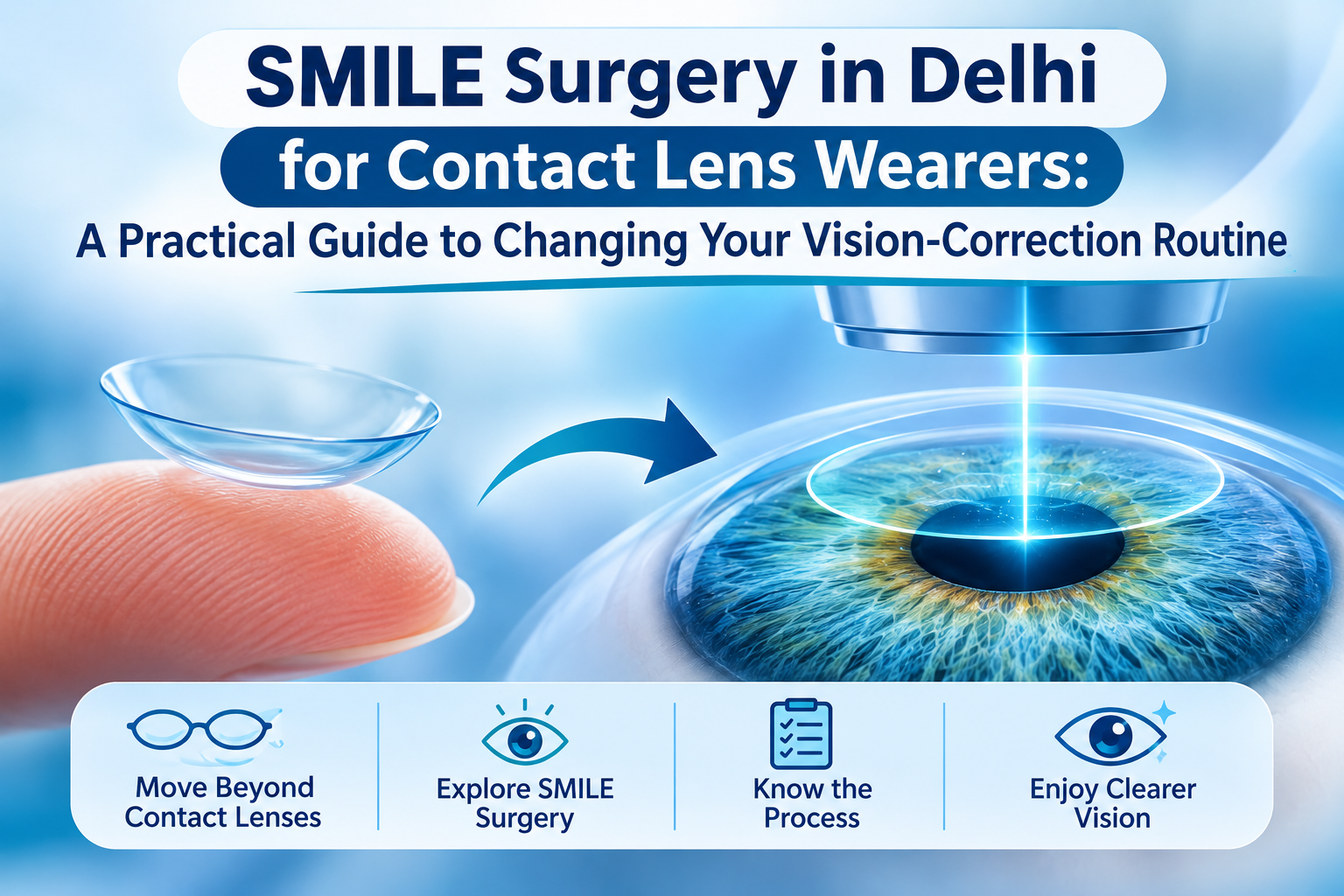
For many contact lens wearers, the question about laser vision correction starts with everyday inconvenience. You may be comfortable wearing lenses most days but find them tiring during long office hours, difficult during travel, or inconvenient when you have to manage cleaning solutions and replacement schedules. If you are considering SMILE surgery in Delhi, the important question is not whether the procedure sounds more convenient. It is whether your eyes are healthy, your prescription is stable and your corneal measurements show that surgery is a reasonable choice.
SMILE stands for Small Incision Lenticule Extraction. It is a form of laser refractive surgery designed to reduce myopia (short-sightedness), with or without certain types of astigmatism. It does not involve creating the broad corneal flap used in LASIK. However, SMILE is still an operation on the cornea and requires thorough evaluation, informed consent and postoperative care.
This guide addresses issues that are especially relevant if you currently wear daily, monthly, toric, rigid or other contact lenses. It explains why your lens history matters, how to prepare for reliable measurements, what dry-eye symptoms can mean and how to decide whether a change from contact lenses to SMILE is appropriate. It is a supporting guide, not a replacement for the centre’s main SMILE treatment page.
Contact lenses sit directly on the eye’s surface. Even when a lens feels comfortable, it may temporarily alter the shape of the cornea or affect tear-film quality. Both matter when an ophthalmologist measures your eyes for a refractive operation. A spectacle prescription alone cannot show whether the corneal surface is stable or whether an accurate surgical treatment plan is possible.
Your doctor therefore needs a complete contact lens history. This includes the type of lens you wear, the number of hours each day, how many years you have worn lenses, whether you sleep in them, and whether you experience redness, fluctuating vision, burning or dryness. The doctor may also ask about previous infections, episodes of severe pain, allergies and whether your lenses have become less comfortable recently.
The purpose is not to assume that contact lens wearers are unsuitable for SMILE. Many may be eligible. Rather, the aim is to separate symptoms caused by lenses from underlying eye-surface conditions, establish reliable measurements and discuss the benefits and limitations of all options.
The cornea is a transparent, curved structure that helps focus light. Contact lenses can cause temporary changes to its curvature, especially when lenses have been worn for long periods or have a rigid design. If the clinician measures a temporarily altered cornea, the resulting readings may not represent your natural eye shape. That can affect the reliability of refractive planning.
For this reason, you should expect instructions to stop contact lens wear before some or all of your preoperative tests. The required break is not identical for everyone. It depends on lens material, design, duration of use and whether repeat measurements show that the cornea has stabilised. Do not simply remove lenses on the morning of a test and assume the readings will be suitable.
Standard soft lenses may need a shorter discontinuation period than toric soft lenses, rigid gas-permeable lenses or orthokeratology lenses. Rigid and cornea-reshaping lenses can require longer intervals and additional visits. Professional guidance describes variable intervals rather than one universal rule. Your treating ophthalmologist should specify the timing for your lens type and may repeat scans if measurements continue to change.
If you depend on lenses for work or driving, prepare a current pair of spectacles before starting the lens-free period. If your glasses are outdated, discuss this with the clinic. The temporary inconvenience is worthwhile because reliable measurements are more important than fitting testing into a rushed schedule.
A changing scan is useful information, not necessarily a failed screening. It may indicate that the cornea is returning to its normal shape after contact lens use. The clinician may recommend more time without lenses and then repeat refraction, topography or tomography. If the scans remain suspicious, further investigation may be necessary before any surgery is considered.
A responsible surgeon should not proceed merely because the patient has already selected a date. Repeating an examination can protect against making a decision using unstable readings.
A common reason people consider SMILE is that their contact lenses feel dry by the evening. This deserves a specific evaluation. Discomfort may be associated with prolonged lens wear, reduced blinking during screen use, tear-film instability, eyelid inflammation, allergies or unsuitable lens care. In some cases, treating the underlying problem may make contact lens wear comfortable again without surgery.
Equally important, SMILE does not guarantee that pre-existing dryness will disappear. Any corneal refractive surgery may cause temporary dryness or other ocular-surface symptoms. Some studies suggest differences in dry-eye outcomes between SMILE and flap-based LASIK, but individual results vary and people can still have dry eyes after SMILE.
Tell the examining team if you regularly use lubricating drops, remove your lenses early because of discomfort, wake with gritty eyes, or notice blurred vision that improves after blinking. These details help determine whether the ocular surface needs treatment before reliable testing or surgery.
For information about the hospital’s eye-surface assessment, see its Dry Eyes Evaluation page: https://www.bajajeyecarecentre.com/dry-eyes-evaluation.html
A history of changing spectacle numbers may suggest that the refractive error is not yet stable. Your ophthalmologist will look at previous prescriptions and current refraction, considering age and the requirements of the laser system. There is no shortcut based only on the strength of your glasses. Even if your prescription seems unchanged, lens-related corneal effects must be excluded.
Corneal topography and, where available or indicated, tomography help detect changes in corneal contour and patterns associated with disorders such as keratoconus. Corneal pachymetry measures thickness. The surgeon also considers how much tissue would need to be removed and whether the planned correction is compatible with the remaining corneal structure.
A person with excellent contact lens vision may still have abnormal scans. Conversely, having a moderately high prescription does not automatically make someone ineligible. The decision is based on the complete set of findings, not one isolated number.
Clinical examination may assess tear stability, lid margins, blinking patterns and signs of inflammation. If significant dry eye or blepharitis is present, treatment may be recommended before repeating measurements. The aim is both comfort and diagnostic accuracy, because an irregular tear film can make vision and scan readings fluctuate.
An assessment may include examination of the lens, eye pressure and retina depending on the patient’s history and findings. People with high myopia may require particular attention to retinal health. A relevant eye disease, systemic medical condition or medicine may change the recommendation or lead to postponement.
To understand the treatment offered at Bajaj Eye Care Centre, refer to the verified SMILE service page: https://www.bajajeyecarecentre.com/smile-laser-eye-surgery-in-delhi-laser-eye-surgery-in-delhi-lasik-surgery-in-delhi.html
The comparison is not just about convenience. Contact lenses are a removable means of correcting vision. They can be changed when your prescription changes, but they require handling, hygiene and replacement. SMILE changes the corneal shape surgically. Its intended effect is lasting correction of the treated refractive error, but it cannot prevent future eye changes, presbyopia or every need for spectacles.
Contact lenses carry risks of irritation and, especially with unsafe wear or cleaning practices, infection. Surgery avoids the need to place a routine corrective lens on the eye for many patients, but introduces its own risks and recovery requirements. These include possible dry eye, glare or halos, undercorrection or overcorrection, inflammation, infection and rare serious vision complications. Neither option should be described as risk-free.
If your lenses are already comfortable and you have no strong reason to consider an operation, continuing with them or spectacles may be entirely reasonable. If they interfere with daily life, a consultation can help establish whether SMILE offers a meaningful benefit for your particular circumstances.
SMILE uses a femtosecond laser to create a small piece of tissue, called a lenticule, within the cornea. The surgeon removes that tissue through a small incision to change the cornea’s focusing power. It does not create a large LASIK flap. LASIK uses a different approach, and surface laser treatments differ again in tissue handling and early recovery.
The fact that SMILE has no broad corneal flap may be relevant for some people who participate in contact sports or have certain occupational considerations. It does not mean that SMILE is categorically safer or suitable for every patient. Treatment indications, available systems, corneal structure, eye-surface health, visual goals and the surgeon’s assessment all matter.
Some patients may not be suitable for any corneal laser procedure. Depending on the circumstances, glasses, contact lenses or a discussion of other clinically appropriate refractive procedures may be preferable. You should be able to ask why one option is advised and what would happen if you choose not to have surgery.
For an overview of another refractive procedure listed by the centre, see its LASIK treatment page: https://www.bajajeyecarecentre.com/lasik-treatment-in-pitampura-lasik-treatment-cost-pitampura-lasik-eye-surgery-pitampura-lasik-surgery-in-delhi.html
Start by telling the clinic exactly which lenses you wear. Ask whether they want you to attend an initial discussion first or discontinue lenses before diagnostic testing. Keep your glasses available, and bring earlier spectacle or contact lens prescriptions. If your work involves frequent driving, arrange how you will function during the required lens-free period.
Testing may be done over more than one visit, especially when the cornea needs extra time to stabilise. If dryness or inflammation is found, the ophthalmologist may advise treatment and a repeat assessment. This is a clinical decision rather than a delay for administrative convenience.
Ask what visual result is realistic for your prescription, whether a small residual power is possible, and whether you may still need glasses for some activities. You should understand the potential complications, the expected follow-up schedule and the total package of tests, surgery, medicines and review visits before giving consent.
Do not plan to drive home after eye surgery. Arrange someone to accompany you or another reliable means of transport. Take your prescribed medication exactly as directed. The speed of visual recovery varies; temporary blur, light sensitivity, watering or gritty sensation can occur. Follow your surgeon’s advice about screens, exercise, face washing, cosmetics, swimming and returning to work rather than relying on an online timetable.
Postoperative visits allow the clinician to assess healing and respond to concerns. Do not skip them because the first few days feel comfortable. Increasing pain, a meaningful drop in vision, pronounced redness or unusual discharge requires prompt medical attention. Have the treating clinic’s contact details available and seek urgent care if severe symptoms develop.
If you wear toric lenses, tell the clinic the prescription and brand, if known. Toric lenses are designed to correct astigmatism, and their use can affect the timing needed for corneal stabilisation. SMILE can address eligible myopic astigmatism, but the treatable range depends on the system and surgeon’s assessment.
Orthokeratology lenses are specifically intended to reshape the cornea temporarily. This makes a careful lens-free interval and confirmation of stable scans especially important. Do not use the same preoperative schedule given to a friend who wears ordinary soft lenses.
Even if you wear lenses only for weddings, sports or weekends, disclose that history. The examiner needs to know when you last wore them. Occasional use may still influence measurement planning depending on the lens and individual eye response.
If your eyes itch often, you rub them forcefully or you have recurrent redness, tell the doctor. Active ocular-surface inflammation may need attention before surgery. Eye rubbing and abnormal corneal scans may also raise concerns that require further assessment.
Pregnancy and breastfeeding can be associated with changes in refraction or the corneal surface. Elective refractive surgery is commonly deferred during these periods, and suitability should be reassessed later according to clinical advice.
Extended screen use tends to reduce blink frequency and may worsen symptoms of dry eye. If you already remove your lenses after a few hours at work, explain that pattern. Screen habits and ocular-surface treatment may still matter after surgery, even if contact lenses are no longer necessary.
People searching for SMILE surgery in Delhi often compare the technology and initial consultation but forget the practical importance of nearby postoperative care. If you travel regularly across the city, ask how many reviews are expected and how to contact the clinic if symptoms develop outside the planned schedule.
Bajaj Eye Care Centre is located in Pitampura, North West Delhi. Its website lists SMILE laser eye surgery and describes the ZEISS VisuMax femtosecond laser. The centre identifies Dr. Rajiv Bajaj as MBBS, MS (Ophthalmology). These details help patients find a relevant clinical service, but they do not establish an individual patient’s eligibility or predict their outcome.
The site also includes an earlier article focused on general questions before booking SMILE. If you are at the beginning of your research, read that guide alongside this contact lens-specific article: https://www.bajajeyecarecentre.com/blog/smile-surgery-in-delhi-questions-before-booking/
Potentially, yes. The number of years you have worn lenses does not by itself determine eligibility. Your cornea, prescription, tear film and overall eye health must be examined, and contact lens-related effects on measurements need to settle first.
The required period varies. Professional recommendations describe a range for soft lenses, and your ophthalmologist may request a longer break or repeat scans depending on your history. Ask for instructions for your specific lenses before the appointment.
Often they do, because they can change corneal shape more significantly or for longer. The correct timing is individual and should be guided by stable refraction and corneal measurements, not by a universal number of days.
Tell the team. The measurements may need to be postponed or repeated after an appropriate lens-free interval. Concealing recent lens wear can undermine the reliability of surgical planning.
No such result can be promised. Contact lens discomfort has several possible causes, and dry-eye symptoms can occur after refractive surgery. Your eye surface should be assessed and treated when necessary before a surgical decision.
A previous infection does not automatically answer the question. The nature of the infection, any remaining corneal scar, current surface health and overall examination findings are relevant. Active infection must be evaluated and treated before considering elective surgery.
No. It can reduce the refractive error being treated, but residual power, later changes in eyesight or age-related difficulty focusing up close may still make glasses helpful. Your ophthalmologist should explain realistic expectations for your age and prescription.
A future need for contact lenses should be discussed with an eye-care professional. Altered corneal shape and any dryness can affect fitting and comfort. Do not restart lenses soon after surgery without approval from your surgeon.
Not automatically. Your contact lens history is only one factor. Corneal mapping, refractive error, dryness, eye health, occupational needs and the risks of each option are more informative than any single preference.
Bajaj Eye Care Centre lists SMILE services on its official website. You can contact the Pitampura centre to arrange an ophthalmic assessment and ask for instructions about discontinuing your contact lenses before examination.
If you currently wear contact lenses and are considering SMILE surgery in Delhi, begin with an eye examination rather than assuming you are eligible. Ask the clinic what lens-free interval applies to you, what records to bring and whether more than one assessment visit may be needed.
Bajaj Eye Care Centre
101, Vikas Surya Plaza, Plot No. 7, DDA Community Centre, Road No. 44, Pitampura, New Delhi, Delhi 110034 (near M2K Picture Hall)
Phone: +91-9811219959 | 011-47024919
Website: https://www.bajajeyecarecentre.com/
Appointment and contact details: https://www.bajajeyecarecentre.com/eye-care-hospital-in-pitampura-eye-hospital-in-pitampura-eye-clinic-in-pitampura-ophthalmology-clinic-pitampura-rani-bagh-west-delhi.html
For contact lens wearers, the path toward SMILE starts well before the laser appointment. Stopping lenses for an appropriate period, allowing the cornea to stabilise, checking for dry-eye disease and understanding your individual surgical risks are central steps in making an informed decision. SMILE may reduce dependence on contact lenses for eligible patients, but it is not the right option for everyone and it does not guarantee perfect eyesight.
If you are comparing SMILE surgery in Delhi with continued contact lens wear or another refractive treatment, the most useful next step is a complete ophthalmic consultation. The aim should be a clinically appropriate choice that fits your eyes and your long-term visual needs.
 153 Google reviews
101, Vikas Surya Plaza, Plot No -7, DDA Community Centre, Road No-44, Pitampura Delhi (Near M2K Picture Hall Pitampura, Rani Bagh, New Delhi, Delhi 110034
+91-9811219959 / 011-47024919 | bajaj_eyecare@yahoo.co.in
Eye Hospital In Delhi | Eye Hospital Near Me | Eye Clinic Near By


