
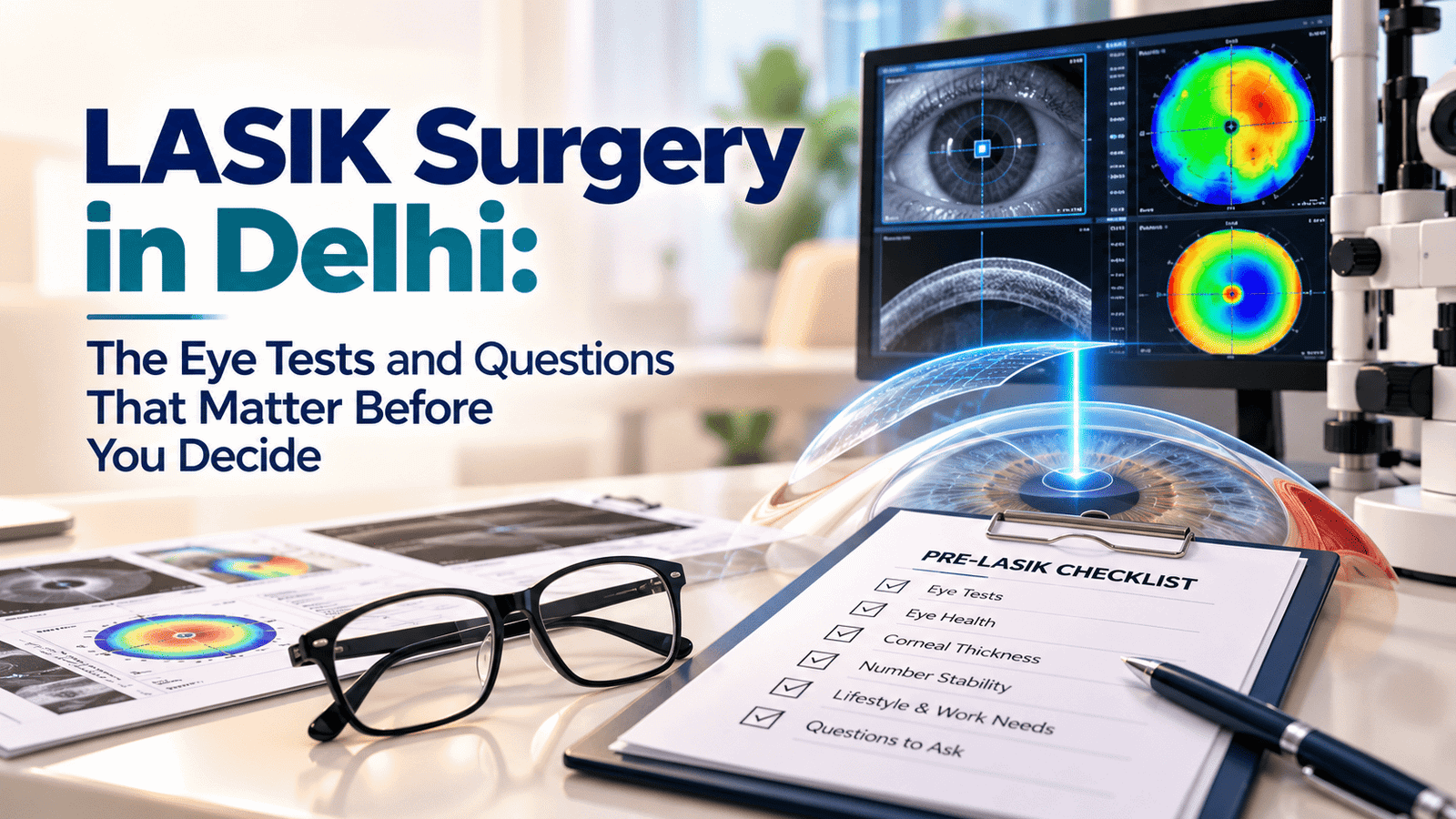
Thinking about removing your glasses is often exciting, but the most useful first question is not “Which laser is newest?” It is “Are my eyes suitable for laser vision correction?” A careful pre-surgery assessment can clarify whether LASIK, SMILE or another option is appropriate for your prescription, corneal health, visual needs and lifestyle. If you are researching a LASIK hospital in Delhi, this guide explains what to expect during screening, what to ask your ophthalmologist and why a personalised recommendation matters more than a procedure label.
At Bajaj Eye Care Centre in Pitampura, Delhi, patients can seek a consultation about laser vision correction, including the LASIK and SMILE services described on the centre’s official website. This article is educational. It does not determine your eligibility or guarantee glasses-free vision; an individual eye examination is essential.
LASIK reshapes the cornea to change how light focuses on the retina. SMILE also changes corneal shape, but removes a small lenticule through a small incision rather than creating a LASIK flap. Both can reduce dependence on spectacles in suitable patients. They are not interchangeable for every prescription or every eye. Suitability depends on the refractive error, corneal measurements, ocular surface, medical history and the treatment range of the equipment being considered.
A consultation is a clinical decision-making process, not simply a test to confirm that the patient wants surgery. It should establish the expected benefit, identify reasons to delay or avoid a procedure, consider alternatives and explain the possibility of residual power, dryness, glare or further treatment. Your surgeon should also discuss what vision you may still need glasses for later in life.
An accurate refraction determines the degree of myopia, hyperopia or astigmatism and is usually compared with previous prescriptions. A stable prescription over approximately the preceding year is commonly part of candidacy assessment, although the exact duration depends on your age, clinical circumstances and procedure. Changes in prescription can continue into early adulthood. Pregnancy, breastfeeding and certain medical conditions can also affect measurements or treatment planning.
Bring old glasses, prescriptions and any previous examination records. If the measurements are still changing, waiting and reassessing may be safer than proceeding with an elective procedure. An ophthalmologist should explain how stability has been established rather than relying only on a verbal estimate of your current power.
Corneal topography or tomography creates detailed information about corneal curvature and shape. These tests help detect patterns that may indicate keratoconus or other corneal abnormalities, which can increase the risk of serious weakening after laser vision correction. Thickness measurements, often referred to as pachymetry, provide further information for planning how much tissue would remain after the proposed correction.
A patient may have a relatively small spectacle number and still be unsuitable for LASIK if the corneal shape is concerning. Conversely, a higher number does not by itself answer whether surgery can be performed. The important question is whether the entire eye is healthy and the planned treatment preserves an acceptable margin of safety. Corneal mapping findings should be interpreted together with refraction, pupil assessment and clinical examination.
Many people already experience dry-eye symptoms because of long screen use, environmental exposure, contact lenses or an unstable tear film. Burning, fluctuating vision, a gritty sensation, watering and discomfort in air-conditioned rooms are useful symptoms to report. LASIK can cause or worsen dry-eye symptoms, so identifying and managing ocular surface disease beforehand is an important part of screening.
Your doctor may assess tear-film quality, eyelid margins and the surface of the cornea. If inflammation or significant dryness is present, treatment and repeat measurements may be needed before any surgical decision. For people with pre-existing dry eye, alternative techniques may be considered, but no procedure should be described as completely free of dry-eye risk.
Learn about the centre’s dry-eye evaluation information here: https://www.bajajeyecarecentre.com/dry-eyes-evaluation.html
Contact lenses can temporarily change the corneal surface and lead to misleading measurements. Before LASIK or SMILE assessment, patients are usually asked to stop wearing lenses for a period advised by their eye surgeon. The duration varies by lens type, duration of wear and whether repeat measurements show that the cornea has returned to a stable shape. Rigid lenses may need a longer break than soft lenses.
Do not choose a lens-free interval from an advertisement or someone else’s experience. Contact the clinic before your evaluation, mention whether you wear soft, toric or rigid lenses, and follow the individual instructions you receive. Bringing your glasses to the appointment makes this period more manageable.
A complete assessment may involve corrected and uncorrected visual acuity, refraction, slit-lamp examination, pupil evaluation, intraocular pressure and examination of the retina where clinically indicated. The surgeon will also review a history of eye injury, keratoconus, glaucoma, retinal disease, prior operations, inflammation or eye infections. Some patients need additional tests or a separate specialist opinion before deciding on elective vision correction.
General health and medication history also matter. Certain autoimmune or poorly controlled conditions may affect healing, and a medication review can identify issues requiring discussion. Do not discontinue prescribed medication without advice from the clinician responsible for it. The consultation should also cover your actual visual requirements, such as prolonged computer work, night driving, sports or occupations with specific medical standards.
Blade-free LASIK usually involves a femtosecond laser to create a corneal flap, followed by an excimer laser that reshapes the cornea beneath it. SMILE uses a femtosecond laser to create a lenticule that is removed through a small incision, without a LASIK flap. Both have established clinical applications, but differences in approved treatment ranges, anatomy, recovery considerations and possible side effects can affect suitability.
There is no single procedure that can be recommended to every patient searching for SMILE surgery in Delhi or a doctor for LASIK in Delhi. A patient with a particular prescription or irregular corneal findings may require a different plan or may not be suitable for corneal laser surgery at all. The surgeon should explain the clinical rationale for the recommended approach and whether non-surgical correction remains preferable.
For the hospital’s existing treatment explanations, see blade-free LASIK: https://www.bajajeyecarecentre.com/lasik-treatment-in-pitampura-lasik-treatment-cost-pitampura-lasik-eye-surgery-pitampura-lasik-surgery-in-delhi.html
For a description of the SMILE procedure, see: https://www.bajajeyecarecentre.com/smile-laser-eye-surgery-in-delhi-laser-eye-surgery-in-delhi-lasik-surgery-in-delhi.html
An unsuitable screening result is clinically useful. It may protect you from undergoing a procedure with an unfavourable risk-benefit balance. Depending on the reason, your ophthalmologist might suggest treating dry eye first, waiting for a stable prescription, continuing with spectacles or contact lenses, or assessing whether an alternative refractive procedure is appropriate. Not all alternatives are offered at every clinic, and each carries its own eligibility requirements and risks.
Corneal irregularity requires particular care. If keratoconus is suspected, the priority may be further testing and management of corneal disease rather than glasses-removal surgery. A decision should never be based only on a package price or an assurance that every spectacle number can be corrected.
A small amount of preparation can make the appointment more informative. Collect recent and older spectacle prescriptions, note your contact lens type, and write down any symptoms such as fluctuating vision, frequent eye rubbing or night glare. Share previous eye diagnoses and surgeries, current medicines and general medical conditions. If dilation may be part of the visit, ask the clinic whether you should arrange transport, as reading and driving may be temporarily affected.
Consider your day-to-day priorities before meeting the doctor. If you spend long hours at a monitor, work in dusty environments, practise contact sports or drive frequently at night, explain these needs. Discuss your expectations in practical terms, including whether the goal is to reduce dependence on distance glasses or to manage near vision as well. The discussion may change with age, especially when presbyopia begins to affect near focus.
Start with the result of the screening: Which findings make me suitable or unsuitable, and is my prescription stable? Ask whether the measured corneal shape and remaining tissue are appropriate for the proposed procedure. Discuss the likely degree of spectacle independence, possible residual power, glare or halos, dry-eye symptoms, infection risk, and how problems would be managed. Ask whether the recommended laser approach has limitations for your prescription.
Practical planning matters as well. Find out how long the examination takes, whether you must stop contact lens wear, what preoperative instructions apply, and when you may return to work, driving, exercise and water activities. Request a written explanation of follow-up appointments, medicines, warning symptoms and total costs, including the possibility of additional care. A clear consultation should allow room for questions and an unhurried decision.
Many suitable patients notice improvement after refractive surgery, but recovery is not identical for everyone. Vision can fluctuate in the initial days, and symptoms such as dryness, light sensitivity, glare or halos can occur. The exact return-to-work timetable differs with the technique, ocular surface and clinical progress. The surgeon will advise when you can safely drive, use eye makeup, exercise and resume activities that expose the eye to impact or contaminated water.
Use postoperative eye drops precisely as prescribed and attend scheduled reviews even if you feel comfortable. Increasing pain, a significant drop in vision, marked redness or other concerning symptoms after surgery require prompt contact with the treating eye-care team. Refractive surgery does not prevent future cataracts, glaucoma, retinal disease or presbyopia, so routine eye care remains important.
For someone comparing a LASIK hospital in Pitampura with other locations in Delhi, a helpful comparison starts with clinical evaluation. Look for a proper refractive work-up, a clear explanation of suitability, a discussion of alternatives, transparent informed consent and an understandable follow-up plan. Convenience of access is useful, but it should not replace attention to screening quality and your surgeon’s judgement.
Bajaj Eye Care Centre is located at 101, Vikas Surya Plaza, Plot No. 7, DDA Community Centre, Road No. 44, Pitampura, New Delhi 110034, near M2K Picture Hall. Its official site identifies Dr. Rajiv Bajaj (MBBS, MS Ophthalmology) and lists LASIK and SMILE among its services. Patients from Pitampura, Rohini, Rani Bagh and other parts of Delhi can contact the centre to enquire about assessment and appointments.
A changing prescription may mean your refractive error is not stable enough for elective surgery. Bring older prescriptions; your ophthalmologist can decide whether repeat refraction and a period of observation are needed.
No. Age alone is not sufficient. Prescription stability, corneal shape and thickness, ocular surface health, other medical conditions and the approved treatment range all matter. Some patients need to wait until their prescription stabilises.
Sometimes, but it depends on severity and response to treatment. Untreated or significant dry eye can make outcomes and comfort less predictable, so the ocular surface should be assessed and optimised first.
No. SMILE does not require a LASIK flap, but it still has limitations and potential side effects. Careful candidate selection, counselling and postoperative follow-up are necessary.
Corneal imaging helps identify shape abnormalities and measure risk factors that cannot be assessed accurately using spectacle power alone. It informs the choice of treatment and may reveal reasons not to operate.
Often yes, but the required interval differs by lens type and your corneal response. Call the clinic for individual instructions; do not assume that the same interval suits every wearer.
No particular result can be promised. Many appropriate patients reduce their dependence on distance spectacles, but residual power or glasses for selected tasks may remain. Reading glasses may still be needed as presbyopia develops.
Night-driving requirements are important to discuss. Glare, halos and fluctuations in vision can occur after laser correction, and a surgeon should review your pupil findings, prescription and work or driving needs before recommending treatment.
Your ophthalmologist may recommend treatment of an underlying problem, a reassessment later, glasses or contact lenses, or evaluation for another suitable technique. A decision not to operate can be the medically appropriate outcome.
The centre lists +91-9811219959 and 011-47024919 for enquiries. Ask about consultation timings, contact lens instructions, likely testing requirements and availability before travelling.
Bajaj Eye Care Centre | 101, Vikas Surya Plaza, Plot No. 7, DDA Community Centre, Road No. 44, Pitampura, New Delhi 110034 (near M2K Picture Hall). Phone: +91-9811219959 / 011-47024919. Website: https://www.bajajeyecarecentre.com/
For official contact and appointment information, visit: https://www.bajajeyecarecentre.com/eye-care-hospital-in-pitampura-eye-hospital-in-pitampura-eye-clinic-in-pitampura-ophthalmology-clinic-pitampura-rani-bagh-west-delhi.html
The right starting point for LASIK surgery in Delhi is a thorough examination, not a promise of a particular result. Stable refraction, corneal imaging, tear-film assessment, medical history and clear counselling help determine whether surgery is appropriate and which option merits discussion. If you are considering reducing your dependence on spectacles, arrange an assessment and make the decision with a qualified ophthalmologist who can explain both the benefits and the limits for your eyes.
Medical disclaimer: This article provides general education and does not replace an individual examination, diagnosis or medical advice. Treatment suitability and recovery plans must be determined by your treating ophthalmologist.
 153 Google reviews
101, Vikas Surya Plaza, Plot No -7, DDA Community Centre, Road No-44, Pitampura Delhi (Near M2K Picture Hall Pitampura, Rani Bagh, New Delhi, Delhi 110034
+91-9811219959 / 011-47024919 | bajaj_eyecare@yahoo.co.in
Eye Hospital In Delhi | Eye Hospital Near Me | Eye Clinic Near By


