
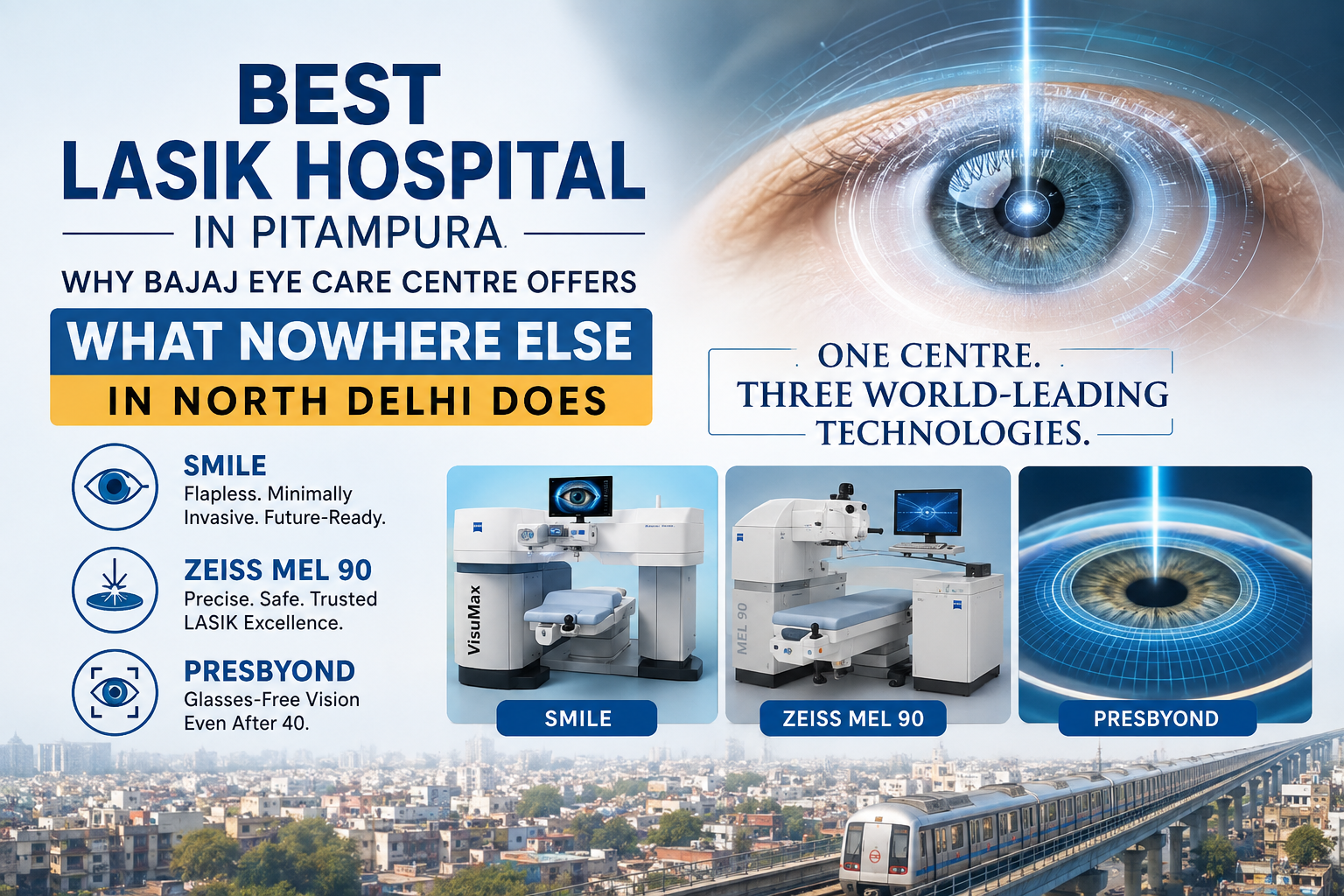
Complete Glasses-Free Delhi — Three Technologies. One Surgeon. One NABH-Accredited Centre.
Est. 1996 | 30+ Years | NABH Accredited | Pitampura Metro, Red Line
+91-9811219959 | 011-47024919 | www.bajajeyecarecentre.com
WEEKLY BLOG — AUGUST 2026 | Primary: Best LASIK Hospital in Pitampura | Secondary: Glasses-Free Delhi · SMILE Surgery Pitampura · Presbyond Delhi | 4000+ Words
SEO + AEO + GEO Optimised | Fact-Verified Facts | MEL 90 + SMILE + Presbyond Clinical Data | Direct-to-Publish
In Pitampura, North Delhi — where lakhs of families live, work, study, and age together — one question echoes consistently across age groups: “Can I live without glasses?” For a 24-year-old software developer who has worn glasses since class six. For a 46-year-old school principal who needs three pairs — distance, reading, and computer. For a 38-year-old defence officer who cannot wear spectacles in the field. The answer in 2026 is a clinically documented, technology-backed yes — and Bajaj Eye Care Centre in Pitampura is where that yes becomes a procedure.
What makes Bajaj Eye Care Centre the best LASIK hospital in Pitampura is not a claim built on advertising. It is a clinical fact built on a three-technology platform that no other eye hospital in North Delhi combines under one roof, under one NABH-accredited surgeon with 30+ years of continuous practice: SMILE on the Zeiss VisuMax (the world’s leading flapless laser vision correction platform), the Zeiss MEL 90 excimer laser (FDA-approved Triple-A ablation for LASIK and Presbyond), and Presbyond Laser Blended Vision (the gold standard for glasses-free life after 40). Together, these three technologies mean that for the first time in Pitampura’s medical history, every patient — regardless of age, power, or the presence of presbyopia — can be offered a genuinely appropriate, clinically evidence-based vision correction pathway at their local eye hospital.
This blog is written directly for patients — not for clinicians. It contains clinically accurate, independently sourced, non-fabricated information about each of these three procedures, the technology behind them, and how Dr. Rajiv Bajaj (MBBS, MS Ophthalmology) applies them to give Pitampura and North Delhi’s working population something that has never been more accessible: permanent, glasses-free vision.
Verified Technology Credentials — Bajaj Eye Care Centre, Pitampura:
Before building a clinical understanding of any procedure, it helps to know what patients in Delhi are actually asking — the real questions typed into Google, asked on WhatsApp groups, discussed in office canteens. This section addresses those searches directly, because organic reach comes from answering real questions, not from repeating marketing language.
🔍 Search: Can I remove my glasses permanently in Delhi?
Answer: Yes — and in 2026, there are more precisely matched pathways than at any point in ophthalmology’s history. SMILE corrects myopia and astigmatism without a flap. Blade-Free LASIK using MEL 90 corrects myopia, hyperopia, and astigmatism with the Zeiss Triple-A algorithm. Presbyond corrects presbyopia (reading glasses dependence) simultaneously with any distance prescription. ICL addresses very high myopia or thin corneas where laser is not appropriate. At Bajaj Eye Care Centre in Pitampura, all four pathways are available. The right one depends on your specific corneal measurements — not on which procedure is currently trending.
🔍 Search: I am 42 and wear both reading and distance glasses. Can laser help me?
Answer: This is the most common unanswered question in Delhi’s refractive surgery market — because most LASIK centres do not offer Presbyond. Bajaj Eye Care Centre does. Presbyond Laser Blended Vision, performed on the Zeiss MEL 90, simultaneously corrects presbyopia and any existing distance prescription. Clinical data published in the Journal of Refractive Surgery (October 2025) confirmed that Presbyond — using the MEL-90 and VisuMax — is “a safe and effective procedure for the treatment of myopic and hyperopic presbyopia.” At 42, you are a strong candidate for evaluation. The answer is not a generic yes or no — it comes after a detailed assessment by Dr. Rajiv Bajaj.
🔍 Search: SMILE vs LASIK — which is better for Delhi’s climate?
Answer: Delhi’s climate — long air-conditioned winters indoors, high-particulate outdoor air, a working population with 8–10 hour screen days — makes dry eye a practical post-operative concern, not a theoretical one. SMILE is clinically superior on this metric: because the Zeiss VisuMax creates no corneal flap, it disrupts far fewer anterior stromal nerves. Fewer cut nerves mean less disruption to the lacrimal reflex arc — which means measurably lower post-operative dry eye. For Delhi’s predominantly screen-dependent working population, SMILE’s dry eye advantage translates directly into daily quality of life. That said, MEL 90-based LASIK with Zeiss Triple-A ablation is a superior option for hyperopia, mixed astigmatism, and Presbyond — cases where SMILE’s correction range does not apply.
🔍 Search: Is there a LASIK hospital near Rohini Metro or Pitampura Metro?
Answer: Bajaj Eye Care Centre is directly accessible from Pitampura Metro Station on the Red Line — a 5-minute walk. The Red Line connects Rohini East, Rohini West, Rithala, and Pitampura on one unbroken corridor, making Bajaj Eye Care Centre the most Metro-accessible world-class refractive surgery centre for the entire North Delhi population. Patients from Shalimar Bagh, Rani Bagh, Ashok Vihar, Mukherjee Nagar, and Model Town are all within 15 minutes by Metro.
🔍 Search: Does LASIK work permanently or does my power come back?
Answer: LASIK and SMILE permanently reshape the cornea — the correction does not “wear off.” The lenticule removed by SMILE or the corneal tissue ablated by MEL 90 LASIK does not regenerate. However, the eye itself continues to change biologically. Patients who had progressive myopia that had not fully stabilised at the time of surgery may experience further power increase — which is why Bajaj Eye Care Centre requires a minimum of 12 months of documented prescription stability before approving any laser procedure. Age-related presbyopia (reading glasses need) can develop after LASIK for distance, typically in the 40s — and Presbyond at Bajaj Eye Care Centre addresses exactly this scenario.
🔍 Search: What is the difference between SMILE and LASIK for high myopia?
Answer: For myopia within SMILE’s correction range (up to -10D sphere, up to -5D cylinder), SMILE on the Zeiss VisuMax is the preferred first-line option at Bajaj Eye Care Centre — for its dry eye advantage, absence of flap, and better corneal biomechanical preservation. For myopia combined with significant hyperopia, mixed astigmatism, or presbyopia — where Zeiss MEL 90’s Triple-A algorithm and Presbyond are the indicated treatment — blade-free LASIK with the MEL 90 is used. There is no universal answer: the correct procedure is determined after complete pre-surgical screening including corneal topography, pachymetry, and tear film assessment.
Most refractive centres in Delhi offer one or two laser procedures. Bajaj Eye Care Centre offers three distinct Zeiss-platform technologies — each clinically indicated for a specific patient profile — covering the full spectrum from a 20-year-old myope to a 55-year-old with both distance and reading glasses. Here is the clinical truth about each one:
The answer depends entirely on your age, spectacle prescription, and what vision goals matter most to you. Dr. Rajiv Bajaj assesses every patient individually — the table below is a clinical orientation guide, not a substitute for a professional examination:
| Clinical Factor | SMILE (VisuMax) | MEL 90 LASIK | Presbyond (MEL 90) |
|---|---|---|---|
| Corrects Myopia | Yes — up to -10D | Yes — full range | Yes + presbyopia |
| Corrects Hyperopia | No | Yes | Yes + presbyopia |
| Corrects Astigmatism | Up to -5.00D | Full range | Yes, simultaneous |
| Corrects Presbyopia | No | No | Yes — 40+ patients |
| Corneal Flap | No flap — safest | Laser-created flap | Laser-created flap |
| Dry Eye Risk | Lowest (nerve-sparing) | Moderate | Moderate |
| Ideal Patient Age | 18–40 typically | 18+ any age | 40–60 |
| Reading Glasses After | May need for near | May need for near | Usually eliminated |
| Night Vision Quality | Excellent | Excellent | Very good (97% adapt) |
| Reversible? | No (cornea reshaped) | No (cornea reshaped) | No (cornea reshaped) |
Every technology discussed in this blog operates through the hands and clinical judgement of Dr. Rajiv Bajaj — MBBS, MS Ophthalmology (Delhi University), founder of Bajaj Eye Care Centre and its only senior surgeon for 30+ years. Before establishing the centre in 1996, Dr. Bajaj trained at Safdarjang Hospital, Dr. Ram Manohar Lohia Hospital, Maharaja Agrasen Hospital, and Sant Parmanand Hospital — accumulating hospital-grade surgical experience across Delhi’s major public sector institutions before entering independent practice.
In refractive surgery, surgeon experience is not a soft credential — it is the primary determinant of outcome. The MEL 90’s ablation algorithm is only as accurate as the surgeon’s pre-operative measurement of the corneal parameters it relies on. Presbyond’s Blend Zone is only as effective as the surgeon’s binocular vision assessment and dominant eye determination. SMILE’s lenticule extraction is a manual step that requires tactile precision. None of these technologies operate independently of the surgeon. Dr. Bajaj’s 1,50,000+ surgical procedures over three decades are the clinical substrate that makes these technologies deliver results — not the other way around.
His most important clinical characteristic — noted consistently in patient reviews — is his commitment to honest candidacy assessment. He recommends against surgery when pre-surgical parameters are borderline. He has turned away patients who have come from other states specifically for SMILE, because their corneal topography revealed early keratoconus that the patient’s previous clinic had not flagged. In a city where patient volume creates financial pressure to approve borderline cases, this commitment to the patient over the procedure is the clearest indicator of genuine clinical excellence.
At Bajaj Eye Care Centre, no laser procedure is confirmed before a complete 2–3 hour pre-surgical screening. For SMILE, this includes corneal topography, pachymetry, tear film assessment, manifest and cycloplegic refraction, pupil size in scotopic conditions, and dilated fundus examination. For Presbyond specifically, an additional step is mandatory: a pre-operative contact lens trial simulating blended vision. This trial — done with a contact lens in the consulting room — allows the patient to experience approximately what Presbyond’s Blend Zone will feel like before committing to surgery. Only patients who tolerate and appreciate the contact lens simulation are approved for Presbyond. This patient-protection step is the published clinical standard recommended by Carl Zeiss Meditec for Presbyond — and Dr. Bajaj follows it without exception.
| Service | Clinical Description |
|---|---|
| SMILE (Zeiss VisuMax) | Flapless, blade-free myopia and astigmatism correction. No flap displacement risk. Lowest dry eye profile. 13M+ eyes treated globally. |
| Blade-Free LASIK (MEL 90) | Zeiss Triple-A excimer ablation. FDA-approved for myopia, hyperopia, and mixed astigmatism. 1.3 sec/dioptre ablation speed. Active eye tracker. |
| Presbyond (MEL 90) | Laser Blended Vision for age 40–60 patients. Simultaneously corrects presbyopia and distance prescription. 97% clinical success rate. Replaces bifocals and reading glasses. |
| ICL — Implantable Collamer Lens | Biocompatible phakic lens inside the eye. No corneal ablation. Fully reversible. For very high myopia, thin corneas, and significant dry eye. UV-protective. |
| Cataract Surgery + Premium IOLs | Phacoemulsification with Monofocal, Toric, EDOF, Multifocal, Trifocal IOLs. 40,000+ cataract surgeries. Cashless under CGHS/DGEHS/GIPSA. |
| Keratoconus — C3R/CXL | Corneal Collagen Cross-Linking — halts keratoconus progression. Essential early treatment to prevent corneal transplantation. |
| Medical & Surgical Retina | Diabetic retinopathy (laser + anti-VEGF), AMD, retinal detachment surgery, macular hole repair, intravitreal injections. |
| Glaucoma | IOP measurement, OCT RNFL, visual field, SLT laser, trabeculectomy. From screening to surgical management. |
| Oculoplasty | Ptosis, DCR, entropion, ectropion, eyelid tumour, orbital fracture. |
| Paediatric Ophthalmology | Refraction, amblyopia therapy, squint correction, myopia control, congenital cataract. |
| Dry Eye Clinic | Schirmer, TBUT, meibomian evaluation. Lubricants through punctal plugs and prescription anti-inflammatory therapy. |
| Green Laser — Diabetic Retinopathy | Focal + panretinal photocoagulation. Anti-VEGF intravitreal injections. Prevents proliferative progression. |
Bajaj Eye Care Centre Expert Blog Series — Published 2026:
Blog 1: Best Eye Hospital in Delhi — Complete Guide 2026
🔗 bajajeyecarecentre.com/blog/best-eye-hospital-delhi/
Full credentials, all services, and what 30 years of NABH-accredited practice means for Delhi patients.
Blog 2: Best LASIK Hospital in Delhi — SMILE, Technology & Clinical Standards
🔗 bajajeyecarecentre.com/blog/best-lasik-hospital-delhi/
Deep comparison of SMILE vs LASIK, clinical evidence for Zeiss VisuMax, and why technology alone is not enough.
Blog 3: Why Delhi Patients Are Choosing SMILE Over LASIK in 2026
🔗 bajajeyecarecentre.com/blog/why-delhi-patients-choosing-smile-over-lasik-2026/
MEL 90 vs SMILE clinical comparison, dry eye data, and corneal biomechanics evidence.
Blog 4: Delhi Monsoon & Eye Health — What Every Patient Must Know
🔗 bajajeyecarecentre.com/blog/delhis-monsoon-season-and-your-eyes-what-every-patient-must-know/
Seasonal conjunctivitis guide, post-surgery care during monsoon, and when to visit urgently.
Blog 5: Best Eye Hospital in Rohini & Pitampura — Local Guide 2026
🔗 bajajeyecarecentre.com/blog/best-eye-hospital-rohini-pitampura/
Metro connectivity guide, CGHS empanelment details, and complete service listing for North Delhi patients.
Website: www.bajajeyecarecentre.com
Google My Business: https://share.google/pymqJlpMS2xdjj7sr
Book Appointment: bajajeyecarecentre.com/eye-care-hospital-in-pitampura-eye-hospital-in-pitampura-eye-clinic-in-pitampura-ophthalmology-clinic-pitampura-rani-bagh-west-delhi.html
Q1. What makes Bajaj Eye Care Centre the best LASIK hospital in Pitampura?
Bajaj Eye Care Centre is the best LASIK hospital in Pitampura because of three combined factors that no other North Delhi eye hospital offers under one roof. First: three Zeiss laser technologies — SMILE on the VisuMax (flapless, blade-free, 13M+ eyes globally), the MEL 90 excimer laser (FDA-approved for myopia, hyperopia, and mixed astigmatism with Triple-A ablation speed of 1 dioptre per 1.3 seconds), and Presbyond Laser Blended Vision (97% success rate for presbyopia correction). Second: Dr. Rajiv Bajaj — MBBS, MS Ophthalmology (Delhi University) — 30+ years of continuous refractive surgery practice at one Pitampura address, 1,50,000+ surgeries, 3,50,000+ patients. Third: NABH accreditation, CGHS/DGEHS empanelment, and a 4.6-star Google rating from 173 verified patient reviews.
Q2. What is Presbyond and is it available in Pitampura?
Presbyond Laser Blended Vision is a laser procedure performed on the Zeiss MEL 90 excimer laser that simultaneously corrects presbyopia (age-related reading glasses dependence) and any existing distance prescription. It creates a Blend Zone — overlapping focal ranges for both eyes — that allows the brain to achieve natural, binocular clear vision at distance, intermediate, and near without glasses. Published clinical data confirms a 97% success rate, compared to 59–67% for conventional monovision. A 2025 peer-reviewed study in the Journal of Refractive Surgery specifically confirmed Presbyond on the MEL-90 and VisuMax platform is “safe and effective for the treatment of myopic and hyperopic presbyopia.” Yes — it is available at Bajaj Eye Care Centre, Pitampura, the only centre in North Delhi offering this procedure under an experienced NABH-accredited surgeon.
Q3. What is the Zeiss MEL 90 and how is it different from other LASIK lasers?
The Zeiss MEL 90 is an excimer laser that received FDA approval in 2025 for all three major refractive indications simultaneously — myopia, hyperopia, and mixed astigmatism — a distinction that Ophthalmology Times described as “a game changer for refractive surgery.” Its Triple-A (Advanced Ablation Algorithm) uses a single optimised ablation profile for the full range of sphero-cylindrical corrections, providing precision and tissue-saving ablation. Its ablation speed — 1 dioptre in as little as 1.3 seconds at 500 Hz — is among the fastest available globally, and its active eye tracker compensates for involuntary eye movements in real time during surgery. The MEL 90 also integrates directly with the Zeiss VisuMax 800 into a unified Corneal Refractive Workflow — the same ecosystem that Bajaj Eye Care Centre uses for both SMILE and Presbyond.
Q4. I wear three pairs of glasses — distance, reading, and computer. Can Presbyond at Bajaj Eye Care Centre help me?
Yes — this is precisely the patient profile Presbyond was designed for. A 46-year-old who carries distance glasses for driving, computer glasses for work, and reading glasses for their phone or newspaper is living with a daily management burden that Presbyond addresses in a single laser procedure. By creating overlapping focal zones for distance, intermediate, and near — rather than forcing the brain to choose between two separate focal points — Presbyond provides the binocular vision at all distances that progressive lenses attempt to replicate optically. Published data documents that 99% of short-sighted and 99% of “reading glasses only” Presbyond patients could read newsprint without glasses. The prerequisite is a pre-operative contact lens simulation at Bajaj Eye Care Centre and a complete pre-surgical screening by Dr. Rajiv Bajaj.
Q5. What is the difference between SMILE and MEL 90 LASIK for myopia correction?
For patients with myopia up to -10D sphere and astigmatism up to -5D cylinder, SMILE on the Zeiss VisuMax is Bajaj Eye Care Centre’s first-line recommendation — because it is flapless, blade-free, disrupts fewer corneal nerves (producing measurably lower post-operative dry eye), and better preserves corneal biomechanical integrity. For patients with hyperopia, mixed astigmatism, or presbyopia — where SMILE’s correction range does not apply — the Zeiss MEL 90 excimer laser is used for blade-free LASIK or Presbyond. Both platforms are from Zeiss’s unified Corneal Refractive Workflow and are operated by Dr. Bajaj with equivalent surgical precision. The decision between them is made based on clinical parameters — not patient preference or procedural pricing.
Q6. Is there an age limit for SMILE, LASIK, or Presbyond at Bajaj Eye Care Centre?
For SMILE and blade-free LASIK: minimum 18 years, with prescription stable for 12+ consecutive months. There is no upper age limit for laser correction — the relevant parameter is corneal health and prescription stability, not age. For Presbyond: typically patients aged 40–60 with presbyopia. Patients must be able to tolerate a pre-operative contact lens simulation of blended vision before being approved for Presbyond surgery. Patients above 60 with cataracts forming may be better served by premium IOL cataract surgery — Dr. Bajaj assesses this individually. Patients below 40 who do not yet have presbyopia but have myopia and/or astigmatism are typically directed to SMILE or LASIK rather than Presbyond.
Q7. Can I have SMILE if I have dry eyes? Will MEL 90 LASIK make dry eyes worse?
SMILE has a documented dry eye advantage over flap-based LASIK because it spares far more anterior stromal corneal nerves — the nerves that drive the lacrimal reflex. Published research confirms fewer dry eye symptoms post-SMILE than post-LASIK. For mild to moderate dry eye, SMILE is often the preferred choice at Bajaj Eye Care Centre. For MEL 90-based LASIK (which involves flap creation), patients with existing dry eye require careful pre-operative tear film assessment. Patients with severe dry eye disease are not cleared for either procedure until the condition is treated — and ICL (which involves no corneal ablation at all) is often the better alternative for this group. Dr. Bajaj performs Schirmer’s test and TBUT at every pre-surgical screening.
Q8. How long does recovery take after SMILE, LASIK, or Presbyond at Bajaj Eye Care Centre?
SMILE: Significant vision improvement typically within 2–6 hours. Day 1: most patients can read phone without glasses. Days 2–3: desk work and computer use resumable. No stitches. No eye patch. Contact sport from Week 4, swimming from Week 6. MEL 90 LASIK: Vision typically clear by the following morning. Desk work by Day 2. Greater initial clarity restoration speed than SMILE, though SMILE has faster sensory recovery of the cornea. Presbyond: Vision clarity begins within 24–48 hours. The brain’s adaptation to the Blend Zone typically completes over 6–12 weeks — most patients notice gradual improvement in their ability to switch between near and distance focus during this period. All post-operative follow-ups — Day 1, Week 1, Month 1, Month 3 — are conducted by Dr. Bajaj personally at Bajaj Eye Care Centre.
Q9. Is Bajaj Eye Care Centre NABH accredited? What does that mean for my safety?
Yes. Bajaj Eye Care Centre holds full NABH (National Accreditation Board for Hospitals & Healthcare Providers) accreditation. NABH is India’s highest institutional healthcare quality standard and requires independent third-party inspection — not self-declaration. The inspection covers patient safety systems, sterilisation protocols, infection control, equipment maintenance and calibration, staff qualification verification, clinical documentation standards, and continuous quality improvement. For patients choosing a laser eye surgery centre in Pitampura or North Delhi, NABH accreditation means the centre has been externally validated to operate at a clinically safe and organisationally sound standard — a verification that many eye centres in Delhi’s competitive market have not undergone or been able to achieve.
Q10. How do I book a SMILE, LASIK, or Presbyond consultation at Bajaj Eye Care Centre?
Appointments can be booked through: Phone: +91-9811219959 or 011-47024919 (Monday to Saturday). WhatsApp: +91-9811219959 — send your name, area, procedure of interest, and preferred date. Online: www.bajajeyecarecentre.com or via the appointment page at bajajeyecarecentre.com/eye-care-hospital-in-pitampura-eye-hospital-in-pitampura-eye-clinic-in-pitampura-ophthalmology-clinic-pitampura-rani-bagh-west-delhi.html. Google My Business: https://share.google/pymqJlpMS2xdjj7sr. Pre-surgical screenings for SMILE, LASIK, and Presbyond require 2–3 hours. Please discontinue soft contact lenses at least 3 days before, and hard lenses at least 2 weeks before. Bring your current spectacle prescription. Arrange a companion to drive you home as dilating drops are used during screening.
BEST LASIK HOSPITAL IN PITAMPURA — BAJAJ EYE CARE CENTRE
SMILE · MEL 90 LASIK · Presbyond · NABH Accredited · 30 Years · Pitampura Metro
Pitampura’s only NABH-accredited eye hospital offering all three Zeiss laser platforms — SMILE, MEL 90 blade-free LASIK, and Presbyond Laser Blended Vision — under one surgeon with 30+ years of continuous practice. Whether you are 22 and ready to remove glasses through SMILE, or 48 and want to be completely free of bifocals through Presbyond — Dr. Rajiv Bajaj and his team at Bajaj Eye Care Centre are ready for your consultation.
📞 +91-9811219959 | ☎ 011-47024919 | 💬 WhatsApp: +91-9811219959
101, Vikas Surya Plaza, Plot No-7, DDA Community Centre
Road No-44, Pitampura, New Delhi — 110034 | Near M2K Picture Hall
Pitampura Metro Station, Red Line — 5-Minute Walk | Monday to Saturday
🌐 www.bajajeyecarecentre.com | GMB: https://share.google/pymqJlpMS2xdjj7sr
📷 instagram.com/bajajeyecarecentre | facebook.com/bajajeyecarecentre | youtube.com/@bajajeyecarecentre
© 2026 Bajaj Eye Care Centre, Pitampura, New Delhi 110034 | NABH Accredited | Best LASIK Hospital in Pitampura | SMILE · MEL 90 · Presbyond · Glasses-Free Delhi | www.bajajeyecarecentre.com
 153 Google reviews
101, Vikas Surya Plaza, Plot No -7, DDA Community Centre, Road No-44, Pitampura Delhi (Near M2K Picture Hall Pitampura, Rani Bagh, New Delhi, Delhi 110034
+91-9811219959 / 011-47024919 | bajaj_eyecare@yahoo.co.in
Eye Hospital In Delhi | Eye Hospital Near Me | Eye Clinic Near By


