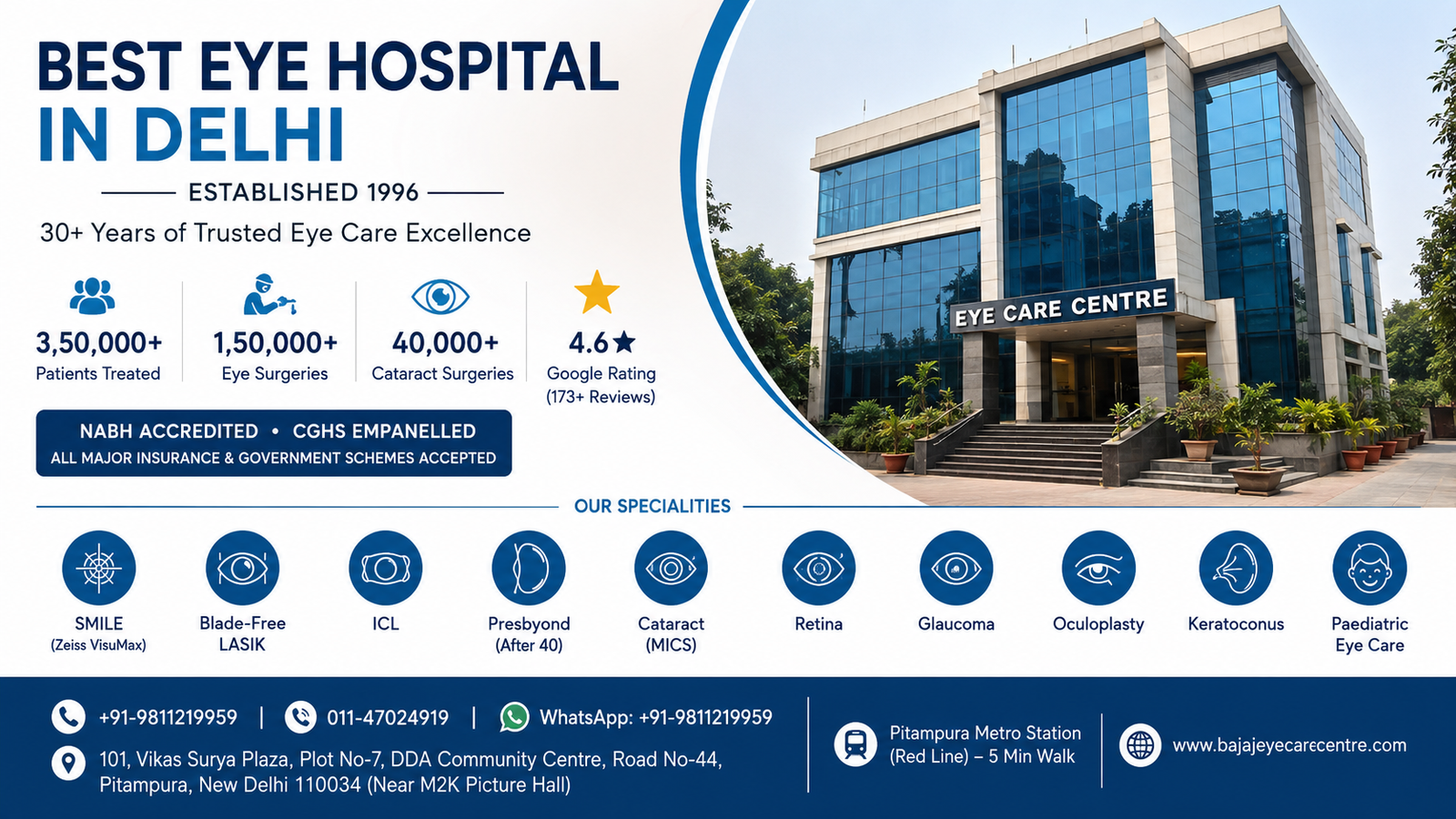
Best Eye Hospital in Delhi — Thirty Years of Earned Trust
There is a difference between a hospital that calls itself the best eye hospital in Delhi and one that has spent three decades building that reputation one patient at a time. Bajaj Eye Care Centre was established in 1996 in Pitampura, North Delhi — and in the thirty years since, it has grown into one of the most trusted, most visited, and most comprehensively equipped eye care centres in the capital. With 500,000+ patients treated, 1,50,000+ eye surgeries performed, and 50,000+ cataract surgeries to its record — all under the direct leadership of Dr. Rajiv Bajaj — the centre’s standing as the best eye hospital in Delhi is built on thirty years of verifiable outcomes, not on marketing alone.
The centre holds NABH accreditation — the National Accreditation Board for Hospitals and Healthcare Providers — India’s highest independent quality standard for healthcare institutions. It is registered with the Directorate of Health Care Services, Delhi, and is empanelled with CGHS, DGEHS, NDMC, MCD, DJB, and Delhi University, as well as being part of the GIPSA group of insurance companies for cashless mediclaim treatment. Patients with government health entitlements and insurance coverage can access care here without financial barriers — a practical advantage that multi-speciality chains often cannot match with the same depth of cashless network at the Empanelment page.
The 4.7-star rating from 173 verified Google reviews is not a number the centre chose — it is the aggregate verdict of patients who walked in, received treatment, and returned home with something changed for the better. Patient testimonials on the centre’s testimonials page and on the Google Business Profile reflect outcomes from cataract surgery, SMILE laser procedures, glaucoma management, retina treatment, and routine consultations. Real names. Real results. The consistent pattern in those reviews is the same: thorough, unhurried care delivered by a team that treats every patient as an individual case — not a number in a queue..
NABH Accredited │ CGHS Approved │ DGEHS │ NDMC │ MCD │ DJB │ GIPSA Cashless │ 4.7★ Google Rating
Bajaj Eye Care Centre — the best eye hospital in Delhi — has served Delhi and North India since 1996 with NABH-verified standards, government empanelment, and 30 years of unbroken clinical practice.
Dr. Rajiv Bajaj — MBBS, MS Ophthalmology | Founder & Senior Ophthalmologist
DR. RAJIV BAJAJ
MBBS, MS Ophthalmology
Founder — Bajaj Eye Care Centre
Pitampura, New Delhi │ Est. 1996
500,000+ Patients Treated
1,50,000+ Eye Surgeries
50,000+ Cataract Surgeries
30 Years Continuous Practice
Dr. Rajiv Bajaj is a Delhi-based ophthalmologist with MBBS and MS Ophthalmology qualifications and over 30 years of uninterrupted clinical and surgical practice. He founded Bajaj Eye Care Centre in 1996 — beginning with a commitment to bringing specialist-level eye care to North Delhi patients who had limited access to technically advanced, affordable ophthalmic services.
Over three decades, he has built a practice spanning the full range of modern ophthalmology: SMILE laser surgery using the Zeiss VisuMax, blade-free LASIK, cataract surgery with advanced phacoemulsification and premium IOLs, medical and surgical retina, glaucoma management, keratoconus treatment with corneal cross-linking, oculoplastic surgery, and paediatric ophthalmology including squint correction.
What the statistics represent — 500,000+ patients treated, 50,000+ cataract surgeries — is not volume for its own sake. It is the accumulation of clinical experience that enables a surgeon to make better decisions under pressure, recognise early warning signs, and counsel patients with the confidence that comes from thirty years of practice. The full doctor profile is available on the website. Patient testimonials from verified Google reviews reflect the experience of those he has treated.
SMILE Laser Eye Surgery — Delhi’s Most Advanced Glasses Removal Procedure
When patients search for the best eye hospital in Delhi for glasses removal, SMILE laser surgery at Bajaj Eye Care Centre is increasingly the answer. SMILE — Small Incision Lenticule Extraction — is the most technologically advanced method of laser vision correction available today. At Bajaj Eye Care Centre, SMILE is performed on the Zeiss VisuMax femtosecond laser — the only globally validated platform for this procedure, developed by Carl Zeiss Meditec.
SMILE — Small Incision Lenticule Extraction │ Zeiss VisuMax Platform
Blade-Free │ Flap-Free │ Flapless │ Stitch-Free │ 2–3 mm Incision
How SMILE Removes Your Glasses
The Zeiss VisuMax laser creates a precisely shaped disc of corneal tissue — called a lenticule — within the corneal stroma, using ultra-short femtosecond laser pulses. This lenticule is defined at a pre-calculated depth and curvature that corresponds to your spectacle prescription. The surgeon then removes the lenticule through the small incision. Removing this disc permanently changes the shape of the cornea, correcting the refractive error that was causing blurred vision. The entire procedure takes approximately 10–15 minutes per eye.
Why SMILE Is Flapless — And Why That Matters
In LASIK, a corneal flap of approximately 18–20 mm circumference is created, lifted, and repositioned after laser reshaping. This flap severs a significant number of anterior corneal nerves, which is the primary reason LASIK patients experience dry eye symptoms post-operatively. In SMILE, no flap is created at any stage. The anterior stroma is accessed only through the 2–3 mm incision. Because fewer anterior corneal nerves are disrupted, the incidence of post-operative dry eye is lower — a fact confirmed by peer-reviewed research including a 2016 meta-analysis published in the Journal of Refractive Surgery.
Corneal Biomechanical Stability After SMILE
Creating a flap in LASIK reduces the structural integrity of the anterior corneal stroma — the region that contributes most significantly to the cornea’s biomechanical strength. SMILE preserves this anterior stroma intact across most of its surface, resulting in measurably better corneal biomechanical stability post-surgery. This is a clinically important advantage for patients in physically demanding occupations, athletes, defence candidates, and those who want long-term refractive stability.
| Parameter | Clinical Fact |
|---|
| Platform | Zeiss VisuMax femtosecond laser (only validated SMILE platform) |
| Procedure type | Flapless, blade-free, intrastromal lenticule extraction |
| Incision size | 2–3 mm |
| Blade used | None — 100% laser-based |
| Stitches | None required |
| Anaesthesia | Topical eye drops — no injections |
| Per-eye duration | 10–15 minutes |
| Flap risk post-surgery | Zero — no flap created at any stage |
| Minimum age | 18 years with stable prescription for 12 months |
| Return to office work | Typically 2–3 days |
| Available at | Bajaj Eye Care Centre, Pitampura, New Delhi |
To learn more or book your SMILE evaluation, visit the SMILE surgery page or call +91-9811219959. You can also book an appointment online.
Blade-Free LASIK Surgery & Vision Correction After 40
Blade-Free LASIK
Blade-free LASIK at Bajaj Eye Care Centre is performed 100% without any blade — using a femtosecond laser for corneal flap creation and an excimer laser for corneal reshaping. This eliminates the mechanical variability of older microkeratome blade-based LASIK and delivers flap dimensions consistent to within microns.
LASIK corrects myopia (short-sightedness), hyperopia (long-sightedness), and astigmatism. The procedure takes approximately 15 minutes per eye, with both eyes typically treated on the same day. Pre-operative evaluation — corneal topography, pachymetry, aberrometry, tear film assessment, dilated fundus examination — determines whether blade-free LASIK is the right choice for each individual.
Not every patient who presents for LASIK is suitable. Insufficient corneal thickness, abnormal topography, active keratoconus, or significant dry eye are conditions that require either SMILE, ICL, or alternative management. At Bajaj Eye Care Centre, patients who are not suitable candidates are told so before surgery is ever scheduled.
Vision Correction After 40 — LASIK After 40
Presbyopia — the loss of near-focusing ability that begins around age 40 — is one of the most universal vision changes adults experience. For patients above 40 tired of reading glasses, Bajaj Eye Care Centre offers Presbyond Laser by Zeiss — a blended vision laser approach that corrects near, intermediate, and distance vision simultaneously.
Presbyond is calibrated to each patient’s neuroadaptability — their brain’s ability to naturally synthesise images at different focal distances — making it a genuinely personalised treatment rather than a generic monovision approach. Patients above 40 who have successfully undergone Presbyond at Bajaj Eye Care Centre report significant reduction or complete elimination of reading glass dependence.
Candidacy requires the same comprehensive pre-operative evaluation as any refractive procedure — corneal assessment, refraction under cycloplegia, and a neuroadaptability evaluation specific to blended vision treatment.
Cataract Surgery in Delhi — 50,000+ Surgeries at Bajaj Eye Care Centre
Cataract surgery is the area in which Bajaj Eye Care Centre’s track record is most directly quantifiable: 50,000+ cataract surgeries performed under the leadership of Dr. Rajiv Bajaj across three decades of practice. Cataract — the clouding of the natural crystalline lens — is the leading cause of reversible blindness in India. At Bajaj Eye Care Centre, surgery is performed using MICS — Micro-Incision Cataract Surgery — through sub-2mm incisions, with phacoemulsification to remove the clouded lens and implantation of a premium intraocular lens (IOL).
MICS — Micro-Incision Cataract Surgery
MICS uses incisions smaller than 2mm — significantly smaller than conventional cataract surgery. The result: less surgically induced astigmatism, no stitches, faster healing, and same-day discharge in the vast majority of cases.
Premium IOL Options:
- Monofocal IOLs — excellent distance vision, reading glasses for near tasks
- Toric IOLs — simultaneous correction of cataracts and astigmatism
- Multifocal IOLs — near and distance vision without glasses
- EDOF IOLs — extended range with superior intermediate vision clarity
- Trifocal IOLs — sharp vision at near, intermediate, and distance in a single implant
IOL selection is based on a detailed lifestyle discussion — your daily visual requirements, occupation, hobbies, and driving habits all inform which lens delivers the best outcome after surgery.
Why Accurate Biometry Matters
The most important determinant of cataract surgery outcome — beyond the surgery itself — is the accuracy of IOL power calculation. Bajaj Eye Care Centre performs biometry using the Argos optical biometer from Alcon, one of the most precise optical coherence biometry systems available globally. Accurate biometry means the implanted lens power is calculated to the highest precision, translating directly into superior visual outcomes post-surgery.
Who Needs Cataract Surgery?
Cataracts develop when proteins in the lens clump together and reduce its transparency. The decision to operate is based on the degree of visual impairment, the patient’s functional needs, and the safety parameters of the individual eye. Surgery is recommended when the cataract is significantly affecting daily activities — not simply because it is visible on examination.
Complete Eye Care — Every Service, Every Age Group
The best eye hospital in Delhi must handle more than spectacle removal and cataracts. Bajaj Eye Care Centre offers the full spectrum of ophthalmic care — serving patients from childhood through senior years, across all common and complex eye conditions:
Medical & Surgical Retina
Dedicated total retina services covering diabetic retinopathy — managed with green laser photocoagulation and intravitreal anti-VEGF injections — age-related macular degeneration (AMD), retinal detachment, macular holes, epiretinal membranes, and vitreous floaters. Surgical retina capability means patients do not need to be referred elsewhere for vitreoretinal procedures.
Green Laser for Diabetic Retinopathy
Diabetic retinopathy is a leading cause of avoidable vision loss in Delhi’s diabetic population. Bajaj Eye Care Centre performs green laser photocoagulation — the standard of care for proliferative diabetic retinopathy — to seal leaking retinal blood vessels and prevent new vessel growth that threatens sight. Early treatment preserves vision that would otherwise be permanently lost to disease progression.
Glaucoma Diagnosis & Treatment
Glaucoma is evaluated with non-contact tonometry (NCT) for IOP measurement, visual field analysis, and OCT of the retinal nerve fibre layer. Medical management with topical therapy is initiated, and laser or surgical intervention — including trabeculectomy — is performed when medically refractory cases require it.
Keratoconus — Corneal Cross-Linking (C3R / CXL)
Keratoconus is a condition of progressive corneal thinning and forward ectatic bulging that causes increasingly distorted vision. C3R — Corneal Cross-Linking with Riboflavin — is performed at Bajaj Eye Care Centre to halt keratoconus progression. It is an absolute contraindication to LASIK and SMILE, which is why corneal topography is mandatory before any laser vision correction recommendation.
Oculoplasty — Eyelid & Lacrimal Surgery
Oculoplasty covers the surgical management of ptosis (drooping eyelid), entropion and ectropion, dacryocystorhinostomy (DCR) for blocked tear ducts causing chronic watering, chalazion excision, eyelid tumour removal, and orbital surgery — all performed at the intersection of clinical function and aesthetic restoration.
Dry Eye Evaluation & Management
Dedicated dry eye evaluation including Schirmer’s test, tear break-up time assessment, and meibomian gland evaluation. Management is individualised: lubricant drops, warm compresses, meibomian gland expression, punctal plugs, and anti-inflammatory therapy for cases with a significant inflammatory component.
Paediatric Ophthalmology & Squint
Children’s eye care includes refraction, amblyopia (lazy eye) therapy using patching and atropine protocols, surgical correction of squint (strabismus) for all types and angles, and management of congenital eye conditions. Early detection in childhood is essential — amblyopia left untreated beyond the critical developmental period results in permanently reduced vision that cannot be fully corrected later.
Intravitreal Injections Clinic
Intravitreal injections of anti-VEGF agents (for wet AMD, diabetic macular oedema, and retinal vein occlusions) and corticosteroid implants are administered in a dedicated procedure environment under strict aseptic protocols, with pre-injection IOP monitoring and post-injection follow-up at each scheduled visit.
Technology & Facilities — What Makes This the Best Eye Hospital in Delhi
Access to world-class surgical platforms makes Bajaj Eye Care Centre the best eye hospital in Delhi for patients who want treatments performed on globally recognised, evidence-backed equipment. Key platforms include:
Zeiss VisuMax Femtosecond Laser SMILE Platform
The Zeiss VisuMax is the only laser on which true SMILE surgery is performed. Its ultra-short femtosecond pulses create the lenticule with micron-level precision, enabling the flapless, blade-free procedure that defines SMILE as a fundamentally different refractive intervention from LASIK. The VisuMax’s low suction pressure during docking minimises intraocular pressure elevation and is associated with a more comfortable intraoperative experience for the patient.
Zeiss Topo-Guided LASIK Personalised Laser Correction
Zeiss Topo-Guided LASIK integrates corneal topography data directly into the excimer laser treatment plan. This allows the laser to correct both the spectacle prescription and the individual surface irregularities of the patient’s unique cornea — delivering visual quality outcomes superior to standard LASIK. Particularly valuable for patients with irregular astigmatism, previous surgery requiring enhancement, or those with the most demanding visual quality requirements.
Zeiss Presbyond Vision Correction for Patients 40+
Presbyond is Zeiss’s proprietary blended vision laser treatment for presbyopia — available at Bajaj Eye Care Centre. It corrects near, intermediate, and distance vision simultaneously, using a blended vision profile calibrated to each patient’s neuroadaptability. Available at only a select number of centres in Delhi — and Bajaj Eye Care Centre is one of them.
Argos Optical Biometry (Alcon) Cataract Surgery Precision
For cataract surgery, IOL power accuracy depends entirely on the precision of biometry. The Argos optical coherence biometer from Alcon measures axial length, anterior chamber depth, lens thickness, and keratometry in a single scan, feeding the data into validated IOL power calculation formulae to determine the precise implant power for each individual eye.
Advanced Phacoemulsification System MICS Cataract
Surgery is performed using an advanced phacoemulsification platform that controls fluidics with precision during lens removal — maintaining stable anterior chamber pressure and protecting the corneal endothelium from unnecessary stress throughout the procedure.
CGHS, DGEHS & Insurance Empanelment — Cashless Eye Care in Delhi
One of the most practical distinctions of Bajaj Eye Care Centre as the best eye hospital in Delhi is the breadth of its government and insurance empanelment. Delhi has a large population of government employees, pensioners, and CGHS beneficiaries who depend on empanelled hospitals for cashless treatment. Bajaj Eye Care Centre is empanelled with CGHS, DGEHS, NDMC, MCD, DJB, and Delhi University, as well as being part of the GIPSA group of insurance companies for private cashless mediclaim treatment.
For patients with Central Government or Delhi Government health entitlements — serving or retired — this means cataract surgery, retina treatment, glaucoma management, and other covered ophthalmic procedures can be accessed at Bajaj Eye Care Centre without out-of-pocket expense.
Government Empanelment Confirmed at Bajaj Eye Care Centre:
CGHSCentral Government Health Scheme
DGEHSDelhi Government Employees Health Scheme
NDMCNew Delhi Municipal Council
MCDMunicipal Corporation of Delhi
DJBDelhi Jal Board
Delhi UniversityAffiliated staff and employees
GIPSA GroupCashless mediclaim for private insurance holders
How to Reach Bajaj Eye Care Centre — From Anywhere in Delhi & Haryana
101, Vikas Surya Plaza, Plot No-7, DDA Community Centre, Road No-44, Pitampura, New Delhi 110034
Near M2K Picture Hall, Pitampura │ Monday to Saturday │ Google Maps Directions
🚇 Delhi Metro
Red Line |
Pitampura Metro Station on the Red Line is the nearest Metro station — a 5-minute walk or brief auto ride from the centre. The Red Line connects to the Yellow Line at Kashmiri Gate (for Central and South Delhi), to the Pink Line at Netaji Subhash Place, and to the Green Line at Inderlok. From Rajiv Chowk: approximately 30 minutes. From Dwarka Sector 21: approximately 45 minutes. |
| 🚗 By Road |
Road No. 44, DDA Community Centre, Pitampura — off the Outer Ring Road and well-connected via GT Karnal Road. Rohini: 10–15 minutes. Shalimar Bagh: 10–15 minutes. Punjabi Bagh: 20 minutes. Janakpuri: 25–35 minutes. Gurgaon via NH-48: 45–55 minutes. |
| 🗺️ From Haryana |
Bajaj Eye Care Centre is among the most accessible NABH-accredited eye hospitals for patients across Haryana. Bahadurgarh: 25–30 minutes. Sonipat: 40–45 minutes. Rohtak: 55–65 minutes. Panipat: 70–80 minutes. Karnal: 85–95 minutes. Many Haryana patients specifically travel to this centre for SMILE surgery, cataract with premium IOLs, and retina treatment. |
| 🚆 By Train |
Delhi Sarai Rohilla Railway Station is directly connected to Pitampura Metro Station via the Red Line — approximately 20 minutes total. New Delhi Railway Station: Yellow Line to Kashmiri Gate, then Red Line to Pitampura — under 40 minutes. Out-of-station patients can plan consultations and same-day return journeys. |
Top 20 Frequently Asked Questions — Best Eye Hospital in Delhi
Every answer below is based on verified facts about Bajaj Eye Care Centre. No hypothetical statements, no general estimates, no assumptions.
Q1When was Bajaj Eye Care Centre established and what is its current patient record?
Bajaj Eye Care Centre was established in 1996 in Pitampura, North Delhi. As of 2026, the centre has treated over 3,50,000 patients, performed more than 1,50,000 eye surgeries, and conducted over 40,000 cataract surgeries. It holds a 4.7-star rating from 214 verified Google reviews. These figures are sourced from the hospital’s own verified records and the Google Business Profile.
Q2Is Bajaj Eye Care Centre NABH accredited?
Yes. Bajaj Eye Care Centre is NABH accredited — the National Accreditation Board for Hospitals and Healthcare Providers — India’s highest standard for quality and patient safety in healthcare. NABH accreditation is independently verified and periodically reassessed. The centre is also registered with the Directorate of Health Care Services, Delhi.
Q3Which government health schemes is Bajaj Eye Care Centre empanelled with?
Bajaj Eye Care Centre is empanelled with CGHS, DGEHS, NDMC, MCD, DJB, and Delhi University. It is also part of the GIPSA group of insurance companies for cashless mediclaim treatment. Full details are on the empanelment page.
Q4What is SMILE surgery and is it available at Bajaj Eye Care Centre?
SMILE (Small Incision Lenticule Extraction) is a flapless, blade-free laser vision correction procedure performed using the Zeiss VisuMax femtosecond laser. A lenticule of corneal tissue is created and extracted through a 2–3 mm incision — no flap, no blade, no stitches. Yes, SMILE surgery is available at Bajaj Eye Care Centre on the Zeiss VisuMax platform.
Q5Does Bajaj Eye Care Centre offer blade-free LASIK?
Yes. Blade-free LASIK is performed at Bajaj Eye Care Centre using a femtosecond laser for flap creation and an excimer laser for corneal reshaping — 100% without any blade. Pre-operative evaluation including corneal topography, pachymetry, and tear film assessment determines candidacy for each patient individually.
Q6What is the difference between SMILE and LASIK?
In LASIK, a corneal flap is created (approximately 18–20 mm arc circumference), lifted, the stroma reshaped, and the flap replaced. In SMILE, no flap is created at any stage — the lenticule is extracted through a 2–3 mm incision. SMILE therefore carries no flap-related risks, disrupts fewer anterior corneal nerves, and preserves greater corneal biomechanical integrity. Both procedures are available at Bajaj Eye Care Centre.
Q7Can patients above 40 get vision correction at Bajaj Eye Care Centre?
Yes. Bajaj Eye Care Centre offers vision correction for patients above 40 through Presbyond Laser by Zeiss — a blended vision laser treatment that corrects near, intermediate, and distance vision simultaneously, reducing or eliminating reading glass dependence for patients with presbyopia.
Q8What cataract surgery options are available at Bajaj Eye Care Centre?
Bajaj Eye Care Centre performs MICS (Micro-Incision Cataract Surgery) with sub-2mm incisions, advanced phacoemulsification, and a full range of premium IOLs: Monofocal, Toric, Multifocal, EDOF, and Trifocal. Biometry is performed using the Argos optical biometer from Alcon.
Q9Does Bajaj Eye Care Centre treat diabetic retinopathy?
Yes. Diabetic retinopathy is managed at Bajaj Eye Care Centre through green laser photocoagulation for proliferative disease and intravitreal anti-VEGF injections for diabetic macular oedema. The retina services page covers all retina treatments available at the centre.
Q10Is glaucoma treatment available at Bajaj Eye Care Centre?
Yes. Glaucoma management spans diagnostic evaluation (NCT for IOP, visual field analysis, OCT RNFL), medical therapy, laser procedures, and surgical intervention including trabeculectomy for medically uncontrolled glaucoma.
Q11What is keratoconus and does Bajaj Eye Care Centre treat it?
Keratoconus is a condition of progressive corneal thinning and forward ectatic bulging. Corneal cross-linking (C3R/CXL) is performed at Bajaj Eye Care Centre to halt keratoconus progression. It is an absolute contraindication to LASIK and SMILE — which is why corneal topography is mandatory before any laser vision correction recommendation is made.
Q12Does Bajaj Eye Care Centre offer squint surgery for children?
Yes. Paediatric ophthalmology and squint services include refraction for children, amblyopia therapy, and surgical correction of strabismus (squint) for all types and angles. Early intervention is critical — amblyopia left untreated beyond the developmental period causes permanent vision loss.
Q13What dry eye services are available?
The Dry Eye Evaluation clinic performs Schirmer’s test, tear break-up time assessment, and meibomian gland evaluation. Treatment options include preservative-free lubricants, meibomian gland expression, punctal plugs, and anti-inflammatory therapy for chronic cases.
Q14Does Bajaj Eye Care Centre perform oculoplasty procedures?
Yes. Oculoplasty procedures performed at the centre include ptosis correction, entropion and ectropion repair, DCR for blocked tear ducts, chalazion excision, and eyelid tumour removal.
Q15What intravitreal injection services are offered?
Intravitreal injections of anti-VEGF agents (for wet AMD, diabetic macular oedema, retinal vein occlusions) and corticosteroid implants are administered under strict aseptic protocols with pre- and post-injection monitoring at every scheduled visit.
Q16What are the verified Google review statistics for Bajaj Eye Care Centre?
Bajaj Eye Care Centre holds a 4.6-star rating from 173 verified Google reviews on its Google Business Profile. Patient testimonials are also published on the centre’s testimonials page and across YouTube patient video reviews.
Q17How can I follow Bajaj Eye Care Centre’s patient education content?
Patient education videos and procedure explainers are available on the YouTube channel. Clinical updates and patient content are shared on Facebook and Instagram. The blog publishes regular eye health content at
bajajeyecarecentre.com.
Q18What is the minimum age for SMILE or LASIK at Bajaj Eye Care Centre?
The minimum age for SMILE, blade-free LASIK, and Topo-Guided LASIK at Bajaj Eye Care Centre is 18 years. The prescription must also have been stable for at least 12 consecutive months before surgery is recommended. These are clinical safety requirements — not administrative thresholds.
Q19How do I reach Bajaj Eye Care Centre by Delhi Metro?
Take the Delhi Metro Red Line to Pitampura Metro Station. The centre is a 5-minute walk or brief auto ride from the station.
Google Maps directions are available for navigation. The address is 101, Vikas Surya Plaza, Plot No-7, DDA Community Centre, Road No-44, Pitampura, New Delhi 110034, near M2K Picture Hall.
Q20How do I book an appointment at Bajaj Eye Care Centre?
Call
+91-9811219959 or
011-47024919.
WhatsApp is available on +91-9811219959.
Online appointment booking is available on the website. Walk-in consultations are also welcome. The centre is open Monday to Saturday.
Delhi’s Eyes Have Trusted Bajaj Eye Care Centre Since 1996
Thirty years is not a marketing claim — it is a clinical track record. Bajaj Eye Care Centre in Pitampura has served 3,50,000+ patients across three decades, performing 1,50,000+ eye surgeries and 40,000+ cataract operations under the direct leadership of Dr. Rajiv Bajaj.
NABH accredited. CGHS empanelled. Zeiss SMILE VisuMax technology. A 4.6-star Google rating from 173 verified patient reviews. These are the facts that define the best eye hospital in Delhi — not advertising slogans.