
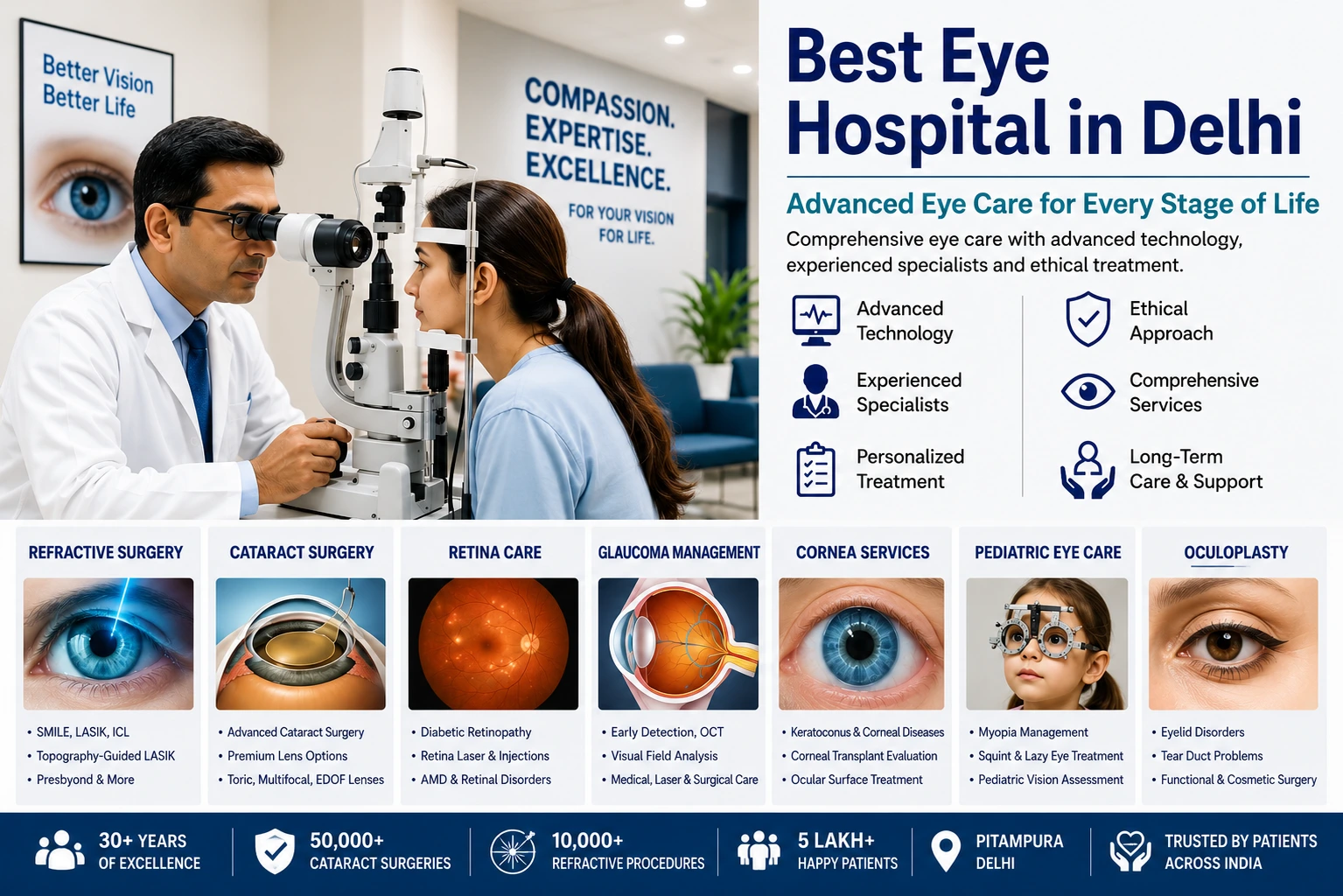
Most patients searching for the Best Eye Hospital in Delhi begin with a simple question:
“Which eye hospital should I trust with my vision?”
However, the answer is rarely as simple as online ratings, advertisements, or social media promotions.
Vision is unique. No two eyes are exactly alike.
A 22-year-old software engineer seeking freedom from spectacles requires a completely different evaluation compared to a 68-year-old diabetic patient preparing for cataract surgery. Similarly, a patient with high myopia and thin corneas may not be a candidate for LASIK but may be an excellent candidate for ICL surgery.
This is where the difference between an eye clinic and a comprehensive eye hospital becomes evident.
At Bajaj Eye Care Centre, every treatment decision begins with one fundamental principle:
Located in Pitampura, Delhi, Bajaj Eye Care Centre has spent more than three decades building a reputation for personalized ophthalmic care, advanced diagnostics, modern surgical technology, and ethical treatment recommendations.
Today, patients travel from Delhi NCR, Haryana, Punjab, Uttar Pradesh, Rajasthan and neighboring states specifically for consultation, second opinions, advanced laser vision correction procedures, cataract surgery, retina treatment, glaucoma management and corneal care.
Delhi has hundreds of eye clinics.
Delhi has dozens of eye hospitals.
But only a handful offer comprehensive ophthalmology services across every major subspecialty of eye care under one roof.
At Bajaj Eye Care Centre, patients can access:
This multidisciplinary approach allows patients to receive comprehensive care throughout every stage of life.
Healthcare technology changes rapidly.
Patient expectations evolve.
Surgical techniques improve.
However, one principle has remained constant at Bajaj Eye Care Centre:
Many patients arrive at the hospital expecting a particular procedure because they have read about it online.
A patient may arrive requesting LASIK.
After detailed evaluation, the best option may be:
The willingness to recommend the most appropriate treatment rather than the most popular treatment is one of the reasons Bajaj Eye Care Centre has earned long-term patient trust.
The journey of Bajaj Eye Care Centre is closely associated with the expertise and leadership of Dr. Rajiv Bajaj.
With more than 30 years of experience in ophthalmology, Dr. Rajiv Bajaj has witnessed the evolution of eye care from conventional surgical techniques to today’s highly advanced laser-based and technology-driven treatments.
Throughout his career, he has remained focused on a single objective:
His experience includes:
Patients often seek consultation not only for treatment but also for second opinions before undergoing eye surgery elsewhere.
This trust has been built through years of consistent outcomes and transparent patient communication.
One of the most overlooked aspects of eye care is diagnostics.
Most patients focus on surgery.
Experienced ophthalmologists focus on diagnosis.
The quality of surgical outcomes is heavily influenced by the quality of pre-operative evaluation.
At Bajaj Eye Care Centre, treatment planning is supported by detailed investigations that help determine:
This comprehensive diagnostic approach helps improve accuracy and predictability.
One of the reasons Bajaj Eye Care Centre has become a trusted destination for eye care in Delhi is its ability to provide age-specific solutions.
Increasing screen time and academic demands have contributed to rising rates of childhood myopia.
Early intervention can significantly reduce future vision complications.
Many professionals seek freedom from spectacles due to:
These patients often explore SMILE, LASIK or ICL after detailed evaluation.
Presbyopia becomes increasingly common after the age of 40.
Many patients become dependent on reading glasses.
Advanced solutions such as Presbyond help address age-related visual changes.
Conditions such as cataract, glaucoma, diabetic retinopathy and age-related macular degeneration require regular monitoring and timely treatment.
Comprehensive care becomes increasingly important during this stage of life.
The true measure of an eye hospital is not the number of procedures performed.
It is the trust patients place in the institution when making decisions about their eyesight.
For more than three decades, Bajaj Eye Care Centre has focused on combining clinical expertise, modern technology, ethical patient care and personalized treatment planning.
Whether a patient requires a routine eye examination, laser vision correction, cataract surgery, retina treatment, glaucoma management, corneal evaluation or pediatric eye care, the objective remains unchanged:
This commitment continues to position Bajaj Eye Care Centre among the most trusted destinations for patients searching for the Best Eye Hospital in Delhi.
One of the most common misconceptions among patients searching for the Best Eye Hospital in Delhi is believing that LASIK is the only solution for removing spectacles.
The reality is very different.
Modern refractive surgery has evolved significantly over the last decade. Today, patients may be suitable for:
The challenge is not choosing a procedure.
The challenge is identifying which procedure is safest and most suitable for a particular eye.
At Bajaj Eye Care Centre, every patient undergoes a detailed refractive surgery workup before any recommendation is made. The objective is simple:
“The best procedure is not the newest procedure. The best procedure is the right procedure for your eyes.”
Across Delhi NCR, there has been a dramatic increase in demand for refractive surgery.
Patients today are looking for:
Common candidates include:
However, not every patient is suitable for the same treatment.
This is where personalized refractive surgery planning becomes critical.
SMILE (Small Incision Lenticule Extraction) is one of the most advanced laser vision correction procedures available today.
Unlike traditional LASIK, SMILE is performed through a very small incision without creating a large corneal flap.
SMILE offers several advantages:
✔ Minimally invasive procedure
✔ Small incision approach
✔ Reduced corneal disruption
✔ Fast recovery
✔ Minimal discomfort
✔ Reduced risk of dry eye symptoms in suitable candidates
✔ Excellent visual outcomes
For many patients with myopia and myopic astigmatism, SMILE has become a preferred option.
Patients typically considered for SMILE include:
However, candidacy is determined only after comprehensive diagnostic testing.
Despite the popularity of SMILE, LASIK remains one of the most successful and widely performed elective procedures in medicine.
Millions of patients worldwide have undergone LASIK successfully.
The reason is simple:
Modern LASIK technology has evolved significantly from earlier generations.
Today’s LASIK procedures are more precise, more customized, and more predictable than ever before.
For many patients, LASIK remains an excellent option for spectacle independence.
One of the most important advancements in refractive surgery is Topography-Guided LASIK.
Traditional laser treatments primarily focus on spectacle power.
Topography-Guided LASIK goes several steps further by analyzing the unique shape and contour of the cornea.
Every cornea has microscopic irregularities.
These irregularities may contribute to:
Topography-Guided LASIK allows surgeons to customize treatment based on the patient’s unique corneal architecture.
✔ Highly customized treatment
✔ Improved visual quality
✔ Better correction of irregular corneas
✔ Enhanced night vision outcomes
✔ Potential reduction in higher-order aberrations
For suitable candidates, this approach can deliver exceptional visual quality beyond standard vision correction.
One of the reasons patients seek consultation at Bajaj Eye Care Centre is to understand whether they are actually candidates for laser vision correction.
Not every patient is suitable for LASIK.
Common reasons include:
Insufficient corneal thickness may make LASIK unsuitable.
Very high refractive errors may be better treated with alternative solutions.
Certain patients require dry eye management before surgery.
Conditions such as keratoconus may require different treatment strategies.
Changing spectacle power may indicate the need for observation before surgery.
Ethical refractive surgery begins with identifying who should NOT undergo LASIK.
Many patients are told they cannot undergo LASIK because of:
For many such patients, Implantable Collamer Lens (ICL) surgery can provide an excellent alternative.
ICL involves placement of a specialized lens inside the eye while preserving the natural lens.
The procedure does not remove corneal tissue.
✔ Suitable for high myopia
✔ Suitable for thin corneas
✔ Excellent visual quality
✔ Reversible procedure
✔ Preserves corneal structure
✔ Useful for patients unsuitable for LASIK
For carefully selected patients, ICL can provide outstanding visual outcomes.
Many individuals believe that once they cross the age of 40, dependence on reading glasses becomes unavoidable.
Modern ophthalmology has changed that perception.
Presbyond is designed specifically for patients experiencing presbyopia.
Presbyopia is the age-related reduction in the eye’s ability to focus on near objects.
Common symptoms include:
Presbyond creates a blended vision system that allows patients to see comfortably across multiple distances.
This includes:
✔ Near vision
✔ Intermediate vision
✔ Distance vision
For suitable candidates, Presbyond can significantly reduce dependence on reading glasses.
Before recommending any procedure, Bajaj Eye Care Centre performs comprehensive testing that may include:
This detailed evaluation helps determine which procedure offers the safest and most predictable outcome.
The future of refractive surgery is not about performing more procedures.
The future is about performing the right procedure on the right patient.
At Bajaj Eye Care Centre, the decision-making process is based on:
This personalized approach helps maximize safety while optimizing visual outcomes.
For thousands of patients seeking freedom from spectacles, Bajaj Eye Care Centre has become a trusted destination because every recommendation is guided by clinical suitability rather than a one-size-fits-all approach.
In the next section, we will explore advanced cataract surgery, premium lens technology, retina services, glaucoma management, cornea care, pediatric ophthalmology, squint treatment, and oculoplasty services that make Bajaj Eye Care Centre one of the most comprehensive eye hospitals in Delhi.
Many patients still believe cataract surgery simply means removing a cloudy lens and replacing it with an artificial lens.
Modern cataract surgery is far more sophisticated.
Today’s cataract procedure is not only about restoring vision lost due to cataracts but also about improving overall visual quality, reducing spectacle dependence, correcting astigmatism, and enhancing daily life.
At Bajaj Eye Care Centre, cataract surgery begins long before the actual operation.
Every patient undergoes a detailed pre-operative evaluation that assesses:
This comprehensive approach helps ensure that the selected lens and surgical plan are tailored specifically to each patient.
One of the biggest misconceptions patients have is that every cataract surgery is the same.
In reality, the quality of visual outcomes often depends on:
Advanced measurements help determine the most suitable intraocular lens (IOL).
Every eye presents unique anatomical considerations.
Different patients have different visual goals.
Undiagnosed retinal disease can affect visual outcomes after cataract surgery.
Successful recovery requires ongoing monitoring.
At Bajaj Eye Care Centre, cataract treatment is approached as a comprehensive vision restoration process rather than simply a lens replacement procedure.
Patients today are increasingly interested in reducing dependence on spectacles after cataract surgery.
Depending upon clinical suitability, lens options may include:
Designed primarily for clear distance vision.
Used to correct pre-existing corneal astigmatism.
Provide vision at multiple distances.
Designed to improve vision across a broader range of distances.
The selection of the appropriate lens depends on:
Personalized lens selection has become one of the most important aspects of modern cataract surgery.
Many retinal diseases develop gradually and often show no symptoms during their early stages.
This is one reason why retinal disorders remain a leading cause of preventable vision loss worldwide.
At Bajaj Eye Care Centre, retina services focus on early diagnosis, timely intervention, and long-term disease management.
India is witnessing a rapid increase in diabetes.
As the number of diabetic patients grows, diabetic retinopathy has become one of the most important causes of preventable blindness.
Patients often experience no symptoms during the early stages.
By the time vision begins to decline, retinal damage may already be significant.
This makes routine retinal screening essential.
At Bajaj Eye Care Centre, diabetic patients undergo detailed retinal evaluation designed to identify retinal changes before permanent vision loss occurs.
AMD affects the central portion of the retina responsible for detailed vision.
Common symptoms include:
Early diagnosis plays a crucial role in preserving vision.
Advanced retinal imaging allows specialists to monitor disease progression and determine the most appropriate treatment strategy.
Retinal detachment is one of the most serious retinal conditions.
Warning signs may include:
Prompt diagnosis and treatment significantly improve visual outcomes.
Patients experiencing these symptoms should seek immediate ophthalmic evaluation.
Glaucoma remains one of the most misunderstood eye diseases.
Unlike cataracts, glaucoma often progresses silently.
Many patients experience no pain, redness, or noticeable symptoms until substantial vision loss has already occurred.
For this reason, glaucoma is often called:
Vision lost from glaucoma is usually irreversible.
Early diagnosis remains the most effective strategy for preserving vision.
Patients at increased risk include:
Comprehensive glaucoma evaluation may include:
Used to assess the optic nerve and nerve fiber layer.
Helps detect functional vision loss.
Provides valuable information regarding glaucoma risk.
Allows specialists to identify early structural changes.
These investigations help detect glaucoma before significant visual damage occurs.
Glaucoma treatment is highly individualized.
Depending on disease severity, management may involve:
The goal is simple:
Early intervention remains the most powerful tool against glaucoma-related blindness.
The cornea is the transparent front surface of the eye responsible for focusing light.
Even small abnormalities can significantly affect visual quality.
Corneal disorders may result from:
At Bajaj Eye Care Centre, corneal evaluation plays a central role in both disease management and refractive surgery planning.
Keratoconus causes progressive thinning and irregularity of the cornea.
Symptoms may include:
Early diagnosis is critical because intervention during the initial stages may help stabilize progression.
Corneal mapping and advanced imaging assist in identifying subtle changes before significant vision loss occurs.
Many childhood eye conditions can be treated successfully when detected early.
Unfortunately, children often cannot recognize or communicate visual problems.
Parents should consider comprehensive eye examinations if they notice:
Early intervention can significantly improve long-term visual development.
Myopia is increasing rapidly worldwide.
The combination of prolonged screen exposure, reduced outdoor activity, and educational demands has contributed to rising rates of childhood myopia.
Early monitoring helps reduce the risk of future vision complications associated with high myopia.
Many parents assume squint affects only appearance.
In reality, untreated squint can impact:
Early assessment is essential because treatment outcomes are often better when intervention occurs at a younger age.
Oculoplasty focuses on conditions affecting:
Many patients seek treatment for:
Can interfere with normal vision and daily activities.
May cause discomfort, irritation, and tearing.
Can lead to chronic watering and recurrent infections.
May affect both vision and quality of life.
The objective of oculoplasty is not simply cosmetic improvement but restoration of normal function and comfort.
The eye is a highly interconnected organ.
A patient presenting for cataract surgery may also have:
Treating only one condition without evaluating the entire eye may compromise outcomes.
This is why comprehensive ophthalmology remains one of the strongest advantages of Bajaj Eye Care Centre.
Patients benefit from coordinated care across multiple ophthalmic specialties under one roof.
Whether the concern is cataract, retina, glaucoma, cornea, pediatric ophthalmology, squint, or oculoplasty, the goal remains consistent:
In the final section, we will cover Delhi-specific authority signals, AI search optimization, patient decision-making factors, hospital differentiators, and the Top 20 Frequently Asked Questions that help patients choose the Best Eye Hospital in Delhi.
Choosing an eye hospital is rarely about finding the nearest clinic. It is about finding a centre that can correctly diagnose a problem, recommend the most appropriate treatment, and continue supporting the patient years after the procedure is complete.
This distinction becomes increasingly important in ophthalmology because many eye conditions are interconnected. A patient considering LASIK may also have dry eye disease. A patient preparing for cataract surgery may unknowingly have glaucoma or retinal pathology. A diabetic patient with blurred vision may assume they need a spectacle change when the actual cause is diabetic retinopathy.
The quality of the outcome often depends on how comprehensively the eye is evaluated before treatment begins.
At Bajaj Eye Care Centre, treatment planning is not centred around a procedure. It is centred around understanding the patient’s eye as a complete visual system.
This philosophy has helped the hospital become a trusted destination for patients seeking not only routine eye care but also second opinions for complex or uncertain diagnoses.
Modern ophthalmology has evolved far beyond treating individual diseases.
Today’s patients expect:
Meeting these expectations requires a different approach.
A patient in their twenties considering SMILE surgery has different visual requirements compared to a retired professional preparing for premium cataract surgery. Likewise, a diabetic patient requires a completely different monitoring pathway than a child with progressive myopia.
For this reason, Bajaj Eye Care Centre emphasizes individualized vision planning rather than standardized treatment pathways.
Every recommendation is based upon:
This level of personalization is often what separates a routine consultation from a truly comprehensive ophthalmic evaluation.
Patients frequently ask which machine is the best.
The more important question is:
Advanced diagnostics are valuable only when combined with clinical experience and thoughtful interpretation.
A corneal scan does not decide whether a patient should undergo LASIK.
An OCT machine does not determine the most appropriate glaucoma treatment.
A retinal image does not create a management plan.
Clinical judgement bridges the gap between technology and outcomes.
This combination of diagnostics, interpretation, and patient-specific planning is one of the strongest contributors to successful long-term results.
The strongest healthcare brands are not built through advertising alone.
They are built through:
Many patients arriving at Bajaj Eye Care Centre today were originally referred by family members who underwent treatment years earlier.
Others arrive after consulting multiple centres and seeking a second opinion before making a decision regarding surgery.
This pattern reflects something more valuable than visibility.
It reflects trust.
And in healthcare, trust remains one of the most important indicators of long-term excellence.
A comprehensive eye hospital is not simply a place that offers multiple treatments.
It is a place where different subspecialties work together.
For example:
A cataract patient may require retinal evaluation before surgery.
A glaucoma patient may need corneal imaging.
A diabetic patient may require both retina and cataract management.
A child with progressive myopia may need long-term monitoring strategies.
This integration becomes increasingly important as eye conditions become more complex.
By providing access to refractive surgery, cataract care, retina services, glaucoma management, cornea evaluation, pediatric ophthalmology, squint treatment, and oculoplasty services, Bajaj Eye Care Centre allows patients to receive coordinated care throughout every stage of life.
The future of ophthalmology is moving away from one-size-fits-all treatment.
Patients increasingly expect care that is:
The hospitals that will lead the next generation of eye care are those that combine advanced technology with individualized treatment planning and patient education.
This is the direction in which Bajaj Eye Care Centre continues to evolve.
By combining three decades of clinical experience with modern diagnostic and surgical capabilities, the hospital remains focused on a single objective:
For patients evaluating options for vision correction, cataract surgery, retinal disease management, glaucoma care, pediatric ophthalmology, or comprehensive eye health, the question is no longer simply where to receive treatment.
The question is where to receive care that remains relevant not just today, but for years to come.
For thousands of patients, that journey continues at Bajaj Eye Care Centre.
 153 Google reviews
101, Vikas Surya Plaza, Plot No -7, DDA Community Centre, Road No-44, Pitampura Delhi (Near M2K Picture Hall Pitampura, Rani Bagh, New Delhi, Delhi 110034
+91-9811219959 / 011-47024919 | bajaj_eyecare@yahoo.co.in
Eye Hospital In Delhi | Eye Hospital Near Me | Eye Clinic Near By


