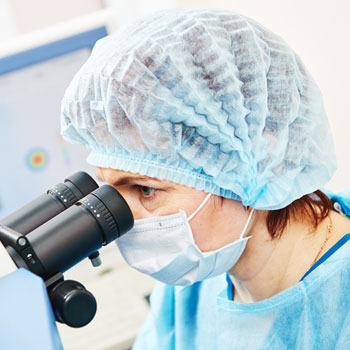
LASIK — Laser-Assisted In Situ Keratomileusis — is one of the most widely performed refractive surgeries in the world, but many patients booking a LASIK consultation in Delhi have only a partial understanding of what actually happens during the procedure. This page walks through LASIK step by step, in the order it actually occurs, so that a patient walking into any LASIK hospital in Delhi — including Bajaj Eye Care Centre — knows exactly what to expect.
Before any LASIK surgery is scheduled, a series of tests establishes whether a patient is a suitable candidate. This includes corneal pachymetry to measure corneal thickness, corneal topography to map the corneal surface and rule out keratoconus, a dry eye assessment, pupil size measurement, and confirmation that the patient's prescription has been stable for at least the preceding 12 months. A patient must be at least 18 years old.
On the day of surgery, the first step is creating a thin flap on the surface of the cornea. This can be done in one of two ways: with a microkeratome, a mechanical blade-based instrument, or with a femtosecond laser, which creates the flap using focused laser energy instead of a blade — this is what "blade-free LASIK" refers to. At Bajaj Eye Care Centre, this step is performed using the Zeiss VisuMax femtosecond laser, creating flaps in the thin 90–100 micron range.
Once the flap is lifted, a second laser — an excimer laser — reshapes the exposed corneal tissue beneath it according to the patient's specific refractive error. At Bajaj Eye Care Centre, this step uses the Zeiss MEL 80 excimer laser. The flap is then repositioned over the treated area, where it adheres naturally without requiring stitches.
The entire procedure typically takes only a few minutes per eye and is performed under topical (drop) anaesthesia, meaning the patient is awake but the eye is numbed. Most patients notice a meaningful improvement in vision within hours, though some blurring, light sensitivity, and mild discomfort in the first 24 hours are common and expected.
Vision is noticeably improved but may still be slightly hazy. Prescribed lubricant and antibiotic drops are used as directed. Eye rubbing must be strictly avoided.
Most patients are able to return to screen-based office work within this window, subject to individual assessment at follow-up.
Light exercise can generally resume, though contact sports and swimming remain restricted.
Swimming and contact sports are generally permitted from around the four-week mark, once the flap has fully stabilised, subject to the surgeon's confirmation at follow-up.
Like any surgical procedure, LASIK carries recognised risks, including temporary or occasionally longer-lasting dry eye, glare or halos around lights (particularly at night, especially in the initial months), under-correction or over-correction requiring enhancement, and, rarely, flap-related complications. Thorough pre-operative screening — particularly ruling out keratoconus and confirming adequate corneal thickness — is the primary way these risks are minimised, which is why a hospital's evaluation process matters as much as its laser technology.
Bajaj Eye Care Centre was the first centre in North and East Delhi to install the Zeiss VisuMax femtosecond laser for 100% blade-free LASIK, and has performed more than 20,000 LASIK surgeries under the direct, personal supervision of Dr. Rajiv Bajaj. The centre is NABH accredited and empanelled with CGHS, DGEHS, NDMC, MCD, and DJB for eligible patients.
Full LASIK procedure page: Blade-Free LASIK at Bajaj Eye Care Centre
All answers below are specific and fact-based. No generalised statements, no hypothetical outcomes.
LASIK (Laser-Assisted In Situ Keratomileusis) is a two-step laser procedure that creates a thin corneal flap and then reshapes the underlying corneal tissue to correct refractive errors such as myopia, hyperopia, and astigmatism.
Conventional LASIK uses a microkeratome, a mechanical blade, to create the corneal flap. Blade-free LASIK uses a femtosecond laser instead, creating the flap through focused laser energy rather than a moving blade.
Corneal pachymetry (thickness), corneal topography (shape, to rule out keratoconus), dry eye assessment, pupil measurement, and confirmation of stable refraction for at least 12 months.
The surgical procedure itself typically takes only a few minutes per eye, though patients should allow time for pre-operative preparation on the day.
LASIK is performed under topical (drop) anaesthesia, and most patients report only mild discomfort during and immediately after the procedure.
Most patients notice meaningful visual improvement within hours, with further stabilisation over the following days.
Most patients return to screen-based office work within 2 to 4 days, depending on individual healing assessed at follow-up.
Recognised risks include temporary dry eye, glare or halos at night, under- or over-correction requiring enhancement, and rarely, flap-related complications — all of which thorough pre-operative screening helps minimise.
The Zeiss VisuMax femtosecond laser for blade-free flap creation and the Zeiss MEL 80 excimer laser for corneal reshaping.
Call +91-9811219959 or 011-47024919, WhatsApp +91-9811219959, or visit Bajaj Eye Care Centre at 101, Vikas Surya Plaza, Plot No-7, DDA Community Centre, Road No-44, Pitampura, New Delhi 110034, Monday to Saturday.
Bajaj Eye Care Centre in Pitampura performs LASIK using the Zeiss VisuMax femtosecond laser and Zeiss MEL 80 excimer laser, with every step of the evaluation, surgery, and follow-up conducted personally by Dr. Rajiv Bajaj across more than 20,000 procedures.
LASIK HOSPITAL IN DELHI
Bajaj Eye Care Centre — Pitampura, New Delhi — Est. 1996 — NABH Accredited
SMILE (Zeiss VisuMax) | Blade-Free LASIK (Zeiss VisuMax + MEL 80) | Cataract MICS (Stellaris)
Retina | Glaucoma | Keratoconus C3R | Oculoplasty | Dry Eye | Paediatric Eye Care
CGHS | DGEHS | NDMC | MCD | DJB | GIPSA | 4.6 ★ Google (153 Reviews)
 153 Google reviews
101, Vikas Surya Plaza, Plot No -7, DDA Community Centre, Road No-44, Pitampura Delhi (Near M2K Picture Hall Pitampura, Rani Bagh, New Delhi, Delhi 110034


